correspondence
Letter to Lal bahadur Shstri
Calcutta · 1965
21 pages
Summary
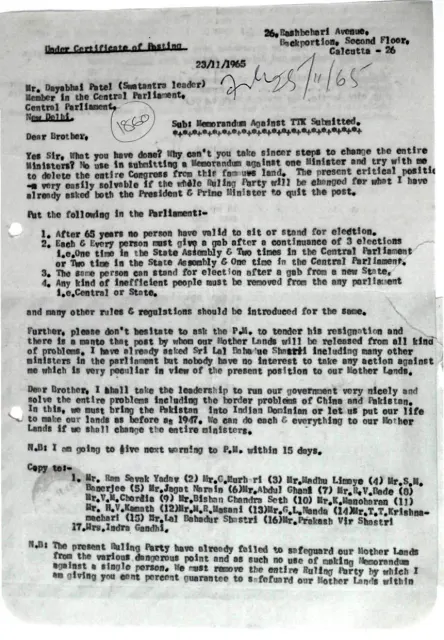
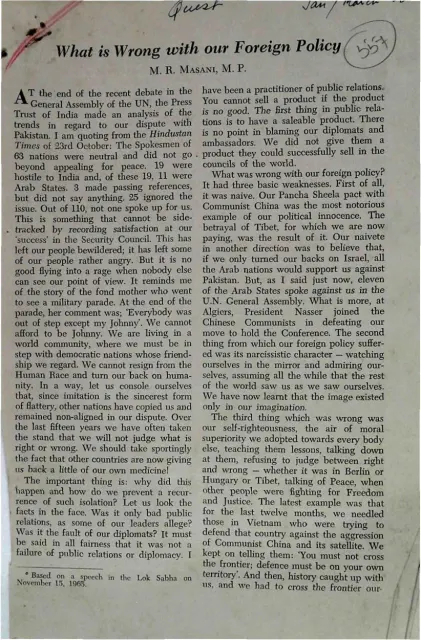
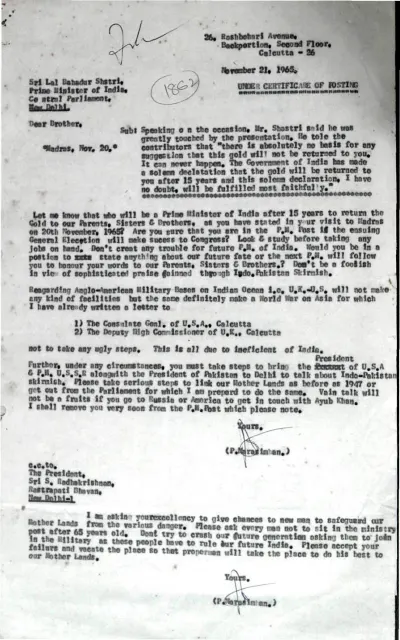
This 1965 correspondence dossier consists of letters signed by P. Narasimhan from Calcutta and addressed to Indian political leaders, foreign diplomatic officials, and the United Nations Security Council. Across the rendered pages, Narasimhan repeatedly challenges the government of Lal Bahadur Shastri, arguing that India’s leadership is failing to address the country’s border disputes, administrative weaknesses, corruption, education, food supply, and relations with Pakistan and China. The letters are urgent, accusatory, and often framed as warnings that the existing political leadership is endangering the country’s future.
The correspondence also advances a strongly interventionist foreign-policy position. Narasimhan opposes British and American military bases in the Indian Ocean, urges India to resist foreign involvement in regional conflicts, and asks the United Nations to address Kashmir, Tibet, Pakistan, Portuguese colonial claims, and the Sino-Indian border. He proposes that Pakistan be brought into an Indian dominion and repeatedly offers himself as someone capable of taking charge of the government. Domestic proposals include age limits and term limits for ministers, free education through the tenth standard, changes to ministerial appointments, and reforms to public-sector bonus arrangements. The final rendered page is an extremely faint continuation or reverse and could not be read reliably.
Key points
- Narasimhan’s letters criticize Lal Bahadur Shastri and other ministers for weak administration, corruption, and inadequate responses to border crises.
- The dossier repeatedly addresses India’s relations with Pakistan, China, Britain, the United States, Portugal, and the United Nations.
- Narasimhan opposes Anglo-American military bases in the Indian Ocean, warning that they could produce a wider Asian war.
- He advocates political turnover, ministerial age and tenure limits, free education through the tenth standard, and the removal of ineffective officeholders.
- The letters challenge the handling of Kashmir, Tibet, the Sino-Indian border, and the aftermath of the 1965 Indo-Pakistan conflict.
- Narasimhan criticizes public-sector bonus policy and argues that workers should receive bonuses where public enterprises earn profits.
- He repeatedly threatens legal action or political action when officials fail to answer his communications.
Metadata and summary are AI-extracted from the source PDF and reviewed for editorial accuracy. The original work is available via the Read PDF tab above (where present); paragraph-level citation inside the PDF is deferred to a future engagement.