letter
Letter to Mr Minoo Masani
NEW DELHI · 1965
11 pages
Summary
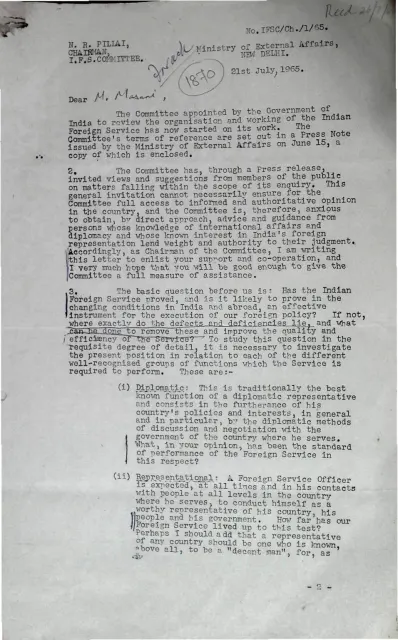
This 21 July 1965 letter from N. R. Pillai, chairman of the committee reviewing the Indian Foreign Service, asks Minoo Masani for informed advice on the Service’s organisation and performance. Pillai frames the central question as whether the IFS remains an effective instrument for executing Indian foreign policy under changing domestic and international conditions. He divides its work into diplomatic, representational, economic and commercial, consular, and information functions, and requests an assessment of each, including the quality of India’s missions abroad and their treatment of visiting Indian nationals.
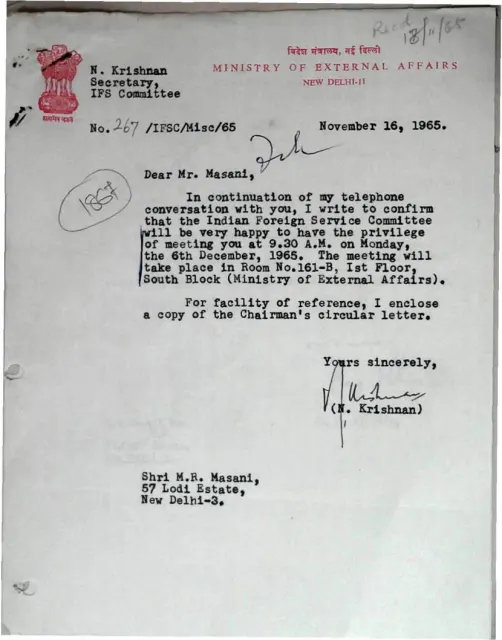
The letter also seeks views on the Service’s recruitment and training system, including a proposal to recruit experienced officers from other services, the length and content of existing training, and the declining popularity of the IFS. At headquarters, it raises questions about unified direction of foreign policy, the Ministry of External Affairs’ responsibility for overseas financial, commercial, publicity, and cultural arrangements, the creation of a policy-planning section, more frequent home postings and inter-ministerial attachments, and continuing contact with universities and the Indian Council of World Affairs. The enclosed press note confirms that the committee was appointed to review the IFS’s structure, recruitment, training, and service conditions and to recommend measures for more efficient functioning at home and abroad. A separate December 1965 note confirms a meeting between the committee and Masani.
Key points
- The IFS Committee was established in 1965 to review the Service in light of changes in India and the wider world.
- The letter asks for an evaluation of diplomatic, representational, economic, commercial, consular, and information functions.
- It treats economic and commercial diplomacy as increasingly important and asks whether officers have adequate expertise and training.
- It questions whether Foreign Service officers remain sufficiently connected with India’s domestic economic, social, and cultural problems.
- It solicits views on recruitment through the UPSC examination versus recruitment from experienced members of other services.
- It identifies training length, language training, allowances, and the declining popularity of the IFS as issues for review.
- It proposes stronger headquarters coordination, a policy-planning section, inter-ministerial attachments, and links with universities and the Indian Council of World Affairs.
Metadata and summary are AI-extracted from the source PDF and reviewed for editorial accuracy. The original work is available via the Read PDF tab above (where present); paragraph-level citation inside the PDF is deferred to a future engagement.