letter
Letter to Mr Minoo Masani
NEW DELHI-1 · 1965
2 pages
Summary
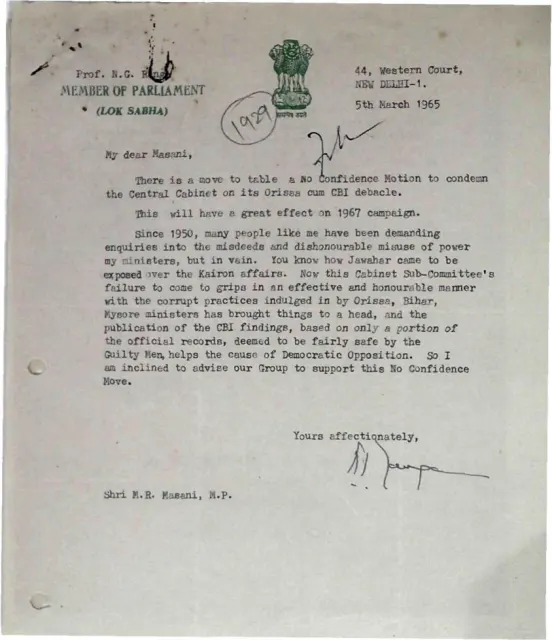
In this letter dated 5 March 1965, Prof. N. G. Ranga urges Minoo Masani to support a no-confidence motion against the Central Cabinet over the Orissa–CBI affair. Ranga argues that the motion could significantly affect the 1967 election campaign and presents the issue as part of a longer pattern of ministerial misconduct, misuse of power, and inadequate accountability since 1950. He maintains that the Cabinet Sub-Committee failed to address corrupt practices involving ministers in Orissa, Bihar, and Mysore, while the publication of selected CBI findings would strengthen the democratic opposition.
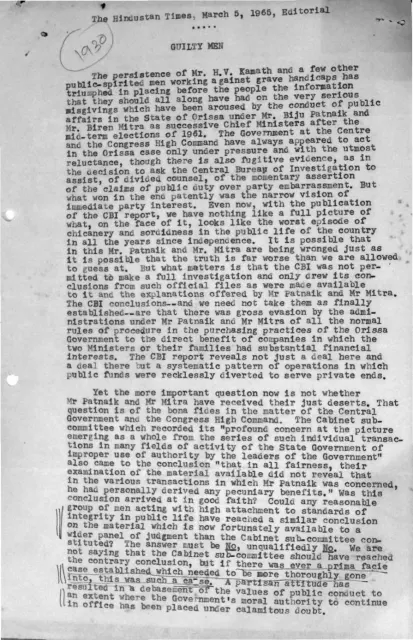
The accompanying copy, addressed to C. Rajagopalachari, broadens the appeal to other opposition groups. It describes the Cabinet Sub-Committee’s conduct as evidence of a lack of public conscience and democratic scruple, cites the Hindustan Times’ criticism of Congress rule, and calls on the opposition to accept its responsibility as the ‘keeper of conscience of our democracy.’ The document records advocacy for parliamentary accountability and coordinated opposition action; it does not include the text of the referenced newspaper cutting or the full enclosed letter beyond the copy shown.
Key points
- Ranga asks Minoo Masani to support a no-confidence motion against the Central Cabinet.
- The proposed motion concerns the government’s handling of the Orissa–CBI affair.
- Ranga links the controversy to alleged ministerial misconduct and misuse of power since 1950.
- He criticizes the Cabinet Sub-Committee’s failure to address corrupt practices involving ministers in Orissa, Bihar, and Mysore.
- The letter argues that publishing selected CBI findings would aid the democratic opposition.
- The accompanying copy urges opposition groups to coordinate and record their willingness to accept parliamentary responsibility.
- The document frames the opposition as the ‘keeper of conscience of our democracy.’
Metadata and summary are AI-extracted from the source PDF and reviewed for editorial accuracy. The original work is available via the Read PDF tab above (where present); paragraph-level citation inside the PDF is deferred to a future engagement.