Summary
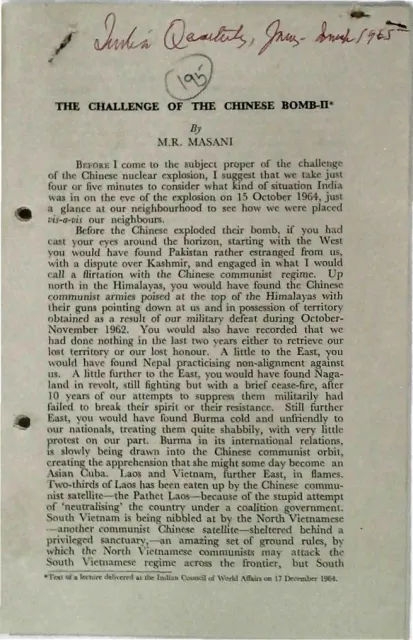
In the rendered pages, M. R. Masani assesses the political and strategic consequences of China’s first nuclear explosion on 15 October 1964 against India’s exposed position in Asia. He describes Pakistan, China, Nepal, Burma, Laos, Vietnam, and Indonesia as forming an increasingly hostile or unstable strategic environment, and argues that the bomb is intended primarily to intimidate China’s neighbours rather than to project power across the Atlantic or Pacific. He rejects reliance on Soviet support, especially after Khrushchev’s removal, and warns that non-alignment cannot mean refusing practical assistance for India’s defence.
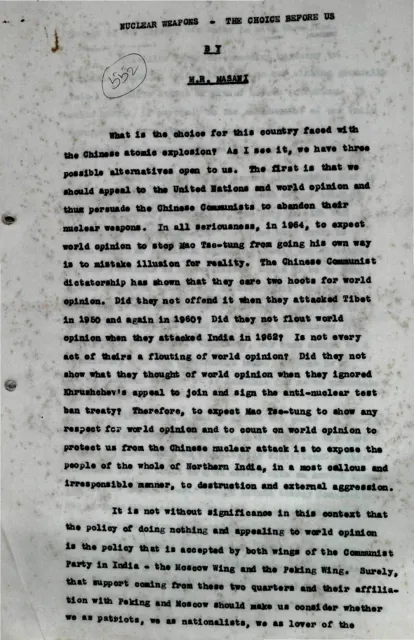
In the rendered pages, Masani considers three responses: appealing to world opinion and the United Nations, building an Indian bomb, and entering an interdependent security arrangement with other free Asian countries and the United States and Soviet Union. He dismisses world opinion as a weak defence, and opposes an independent Indian bomb on economic, logistical, political, and psychological grounds. His preferred solution in the rendered pages is an explicit, automatic nuclear guarantee or deterrent arrangement, which he presents as compatible with a practical understanding of non-alignment. The pages end with his argument that India must discard what he calls the “dead hand of the past” and make present security needs the basis of policy.
Key points
- Masani places China’s nuclear test within India’s vulnerable strategic position after the 1962 war.
- The rendered pages portray China’s bomb as a means of intimidating neighbouring Asian states and strengthening communist diplomacy.
- Masani argues that India cannot safely rely on Soviet military assistance against China.
- He rejects appeals to world opinion and the United Nations as insufficient protection against nuclear blackmail.
- He examines an Indian nuclear weapon but argues that its cost, delivery requirements, and deterrent logic make it impractical.
- He distinguishes genuine non-alignment from refusing all foreign assistance for national defence.
- He advocates an openly negotiated security guarantee involving the United States, the Soviet Union, and other free Asian countries.
- The closing argument calls for abandoning inherited assumptions when they conflict with India’s immediate security.
Metadata and summary are AI-extracted from the source PDF and reviewed for editorial accuracy. The original work is available via the Read PDF tab above (where present); paragraph-level citation inside the PDF is deferred to a future engagement.