minutes · report
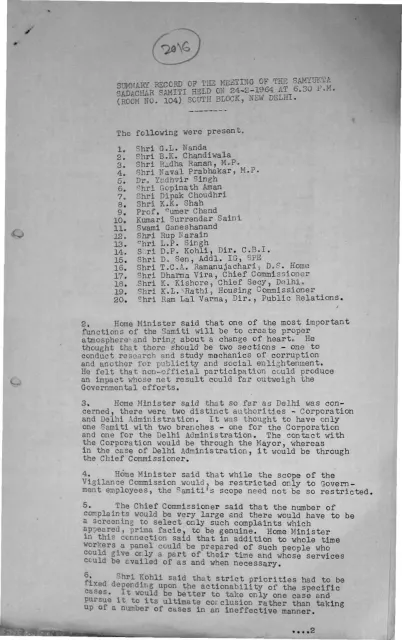
SUMMARY RECORD OF THE MEETING OF THE SAMYUKTA SADACHAR SAMITI HELD ON 24-2-1964 AT 6.30 P.M. (ROOM NO. 104) SOUTH BLOCK, NEW DELHI.
New Delhi · 1964
2 pages
Summary
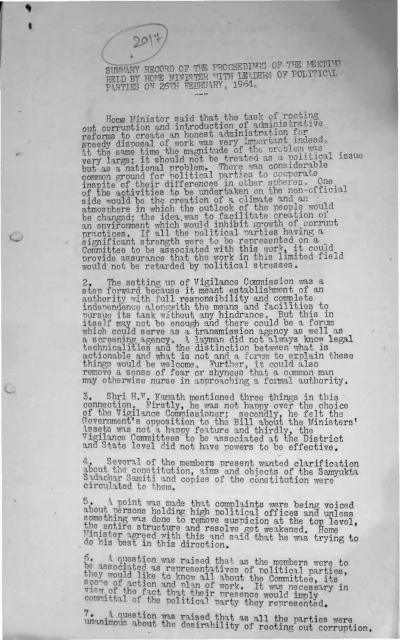
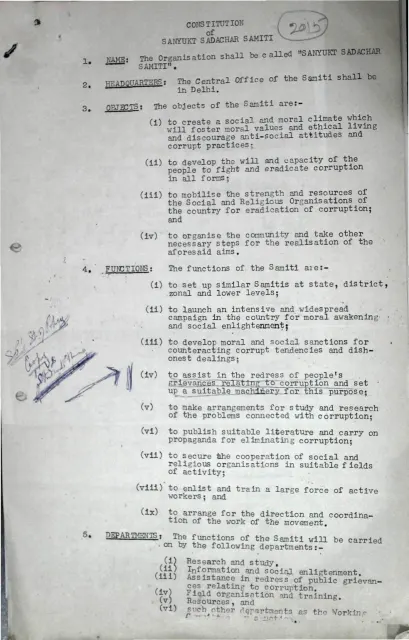
This two-page summary records a meeting of the Samyukta Sadachar Samiti held in New Delhi on 24 February 1964. The Home Minister presents the Samiti as a body that could cultivate a change of public attitudes toward corruption, combining research into its mechanisms with publicity and social education. The discussion proposes two Delhi branches, one for the Corporation and one for the Delhi Administration, and considers a remit broader than that of the Vigilance Commission, which was limited to government employees.
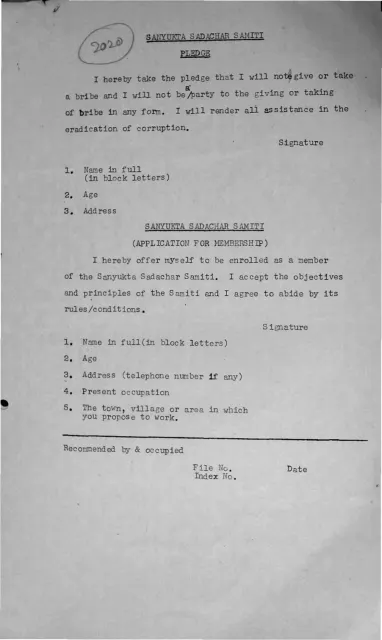
The participants focus on practical mechanisms for handling corruption complaints: screening large numbers of complaints for prima facie genuineness, encouraging witnesses to provide evidence, protecting complainants and witnesses, and improving the institutional handling of complaints against officials. Other proposals include prioritising actionable cases, transferring officers where conviction is not possible for lack of evidence, appointing a liaison officer between the Samiti and the Vigilance Commission, maintaining an open chronological register for telephone allotments, and convening political leaders to frame a code of conduct for legislators and corporation members. The record ends with members taking an oath.
Key points
- The Samyukta Sadachar Samiti is presented as an anti-corruption body combining research, publicity, and social education.
- The Home Minister proposes two Delhi branches to reflect the separate authorities of the Corporation and Delhi Administration.
- The Samiti’s jurisdiction is envisaged as broader than the Vigilance Commission’s government-employee remit.
- Participants stress screening complaints, prioritising actionable cases, and encouraging witnesses to provide evidence.
- The meeting discusses protecting complainants and witnesses and improving the routing of complaints against officials.
- An open chronological register is proposed as a way to make telephone allotments more transparent.
- The record closes with a proposed code of conduct for public representatives and members taking an oath.
Metadata and summary are AI-extracted from the source PDF and reviewed for editorial accuracy. The original work is available via the Read PDF tab above (where present); paragraph-level citation inside the PDF is deferred to a future engagement.