constitution
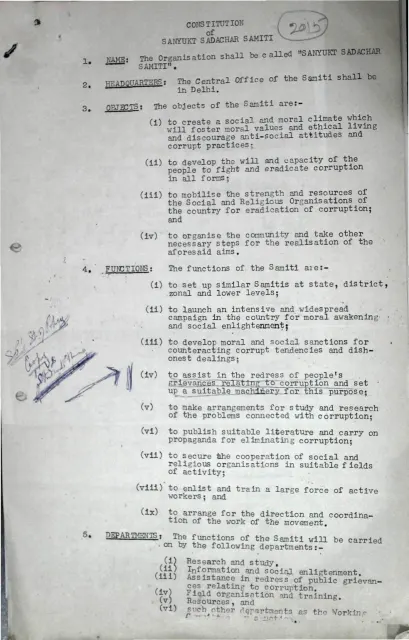
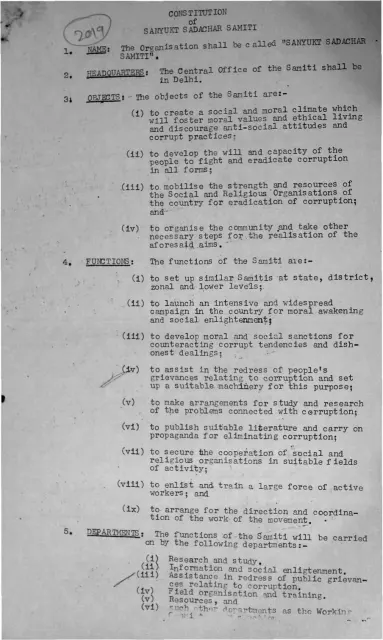
CONSTITUTION of SANYUKT SADACHAR SAMITI
Delhi
3 pages
Summary
This three-page constitution establishes the Sanyukt Sadachar Samiti, with its central office in Delhi, as an organisation dedicated to creating a moral and social climate that fosters ethical conduct and combats corruption. Its stated objects include developing public capacity to eradicate corruption, mobilising social and religious organisations, organising the community, and discouraging antisocial attitudes and corrupt practices.
The document provides for state, district, zonal, and lower-level Samitis; campaigns for moral awakening and social enlightenment; research, public-grievance redress, publications, training, and cooperation with social and religious organisations. Its central structure consists of a General Council and Working Committee. The constitution specifies the composition and tenure of these bodies, gives the Working Committee responsibility for policy execution, funds, property, state units, and committees, and sets out membership, quorum, audit, and financial provisions. Gulzarilal Nanda is named as the first President. No author, publisher, printed publication year, or formal issuer line is visible; the handwritten circled “2019” on page 1 is not treated as a publication date.
Key points
- The Samiti is headquartered in Delhi and is intended to operate through organisational units at state, district, zonal, and lower levels.
- Its central purpose is to foster ethical living, moral values, and social responsibility while eradicating corruption.
- Its functions include public education, research, literature and propaganda, grievance redress, worker training, and cooperation with social and religious organisations.
- The central organisation comprises a General Council and a Working Committee, with the latter responsible for day-to-day administration and execution of policy.
- The Working Committee may administer property and funds, accept donations, invest funds, borrow money, frame rules, establish state units, and appoint ad hoc committees.
- Membership is open to persons aged 18 or above who sign the prescribed pledge; the President may revoke membership, subject to appeal.
- The constitution requires annual auditing, establishes 1 April as the beginning of the official year, and sets quorum rules for the General Council and Working Committee.
Metadata and summary are AI-extracted from the source PDF and reviewed for editorial accuracy. The original work is available via the Read PDF tab above (where present); paragraph-level citation inside the PDF is deferred to a future engagement.