essay
THE COMMONWEALTH CLUB OF INDIA
What it Strives For?
New Delhi
2 pages
Summary
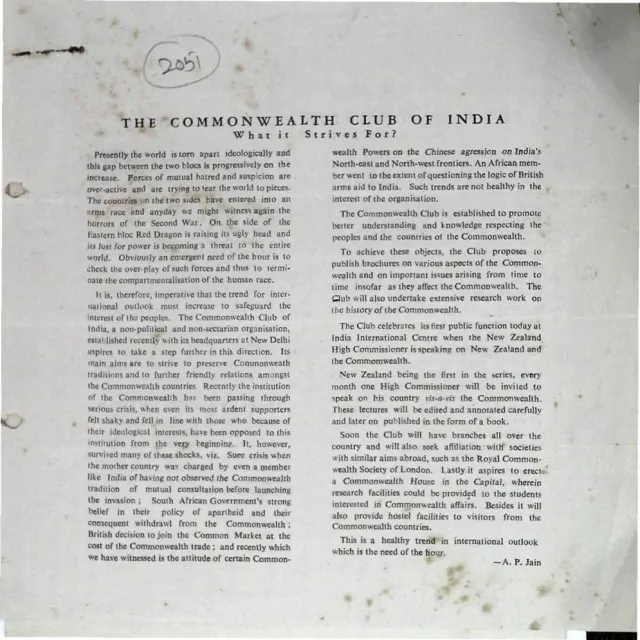
This two-page statement presents the Commonwealth Club of India as a non-political, non-sectarian organisation intended to strengthen understanding and friendly relations among Commonwealth peoples and countries. Its rationale is set against ideological division between the Eastern and Western blocs, the memory of the Second World War, the perceived threat of expanding Soviet power, and disagreements within the Commonwealth over issues including apartheid, the European Common Market, and British arms aid to India. The Club is described as an effort to preserve Commonwealth traditions while encouraging wider international understanding.
The statement outlines a programme centred on public education, research, and institutional exchange. It proposes brochures and books on Commonwealth affairs, lectures by Commonwealth high commissioners, research on Commonwealth history, branches across India, affiliation with similar organisations abroad, and eventually a Commonwealth House in New Delhi with research and residential facilities. The accompanying “Aims and Objects” document specifies meeting space, libraries and newspaper rooms, publications, lectures, comparative studies, student information services, cultural programmes, and funding through membership fees, donations, public collections, charity and advertising campaigns, travel programmes, and Commonwealth House membership.
Key points
- The Club is defined as a non-political and non-sectarian organisation headquartered in New Delhi.
- Its stated purpose is to promote knowledge, understanding, friendly relations, and unity of thought and action across the Commonwealth.
- The rationale responds to Cold War ideological polarisation, the threat of war, and tensions affecting Commonwealth cooperation.
- The Club proposes publications, lectures, historical research, comparative studies, and cultural and educational programmes.
- Its planned facilities include libraries, newspaper rooms, information services, branches across India, and a proposed Commonwealth House in New Delhi.
- The organisation intends to support students, teachers, visitors, and researchers interested in Commonwealth affairs.
- Funding is to come from membership fees, donations, public collections, charity and advertising campaigns, travel programmes, and related sources.
Metadata and summary are AI-extracted from the source PDF and reviewed for editorial accuracy. The original work is available via the Read PDF tab above (where present); paragraph-level citation inside the PDF is deferred to a future engagement.