pamphlet
CONSUMER RESISTANCE
1 pages
Summary
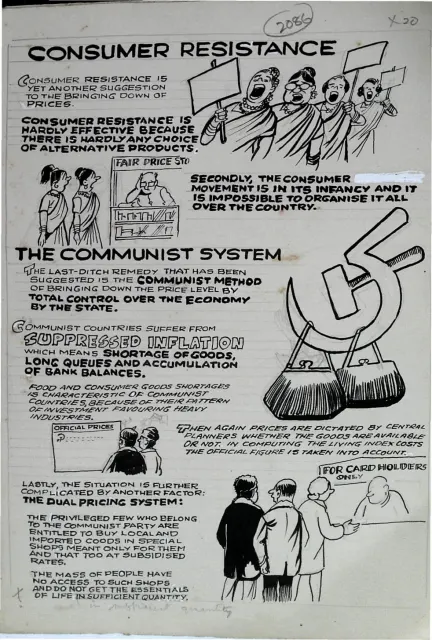
This single-page illustrated leaflet argues that consumer resistance is an ineffective way to reduce prices because consumers have little choice among alternative products and because the consumer movement is too young to organize nationwide. It presents state control of the economy as a “last-ditch remedy,” but uses the communist system as a warning rather than a solution.
The page associates communist economic management with suppressed inflation, shortages of food and consumer goods, long queues, accumulated bank balances, centrally dictated prices, and official cost-of-living figures that may not reflect actual availability. It further criticizes dual pricing: party members receive access to local and imported goods through special shops at subsidized rates, while the wider population lacks access to essential goods. The page does not identify an author, publisher, date, or issuing organization.
Key points
- Consumer resistance is described as ineffective because consumers have few alternative products to choose from.
- The consumer movement is characterized as being in its infancy and unable to organize across the country.
- The communist method is presented as state control over the economy intended to bring down prices.
- Communist economies are said to experience suppressed inflation, shortages, queues, and accumulation of bank balances.
- The page criticizes the concentration of investment in heavy industries as a cause of food and consumer-goods shortages.
- Centrally planned prices and official cost-of-living calculations are portrayed as disconnected from actual availability and living conditions.
- Dual pricing is criticized for giving communist-party members privileged access to subsidized local and imported goods.
Metadata and summary are AI-extracted from the source PDF and reviewed for editorial accuracy. The original work is available via the Read PDF tab above (where present); paragraph-level citation inside the PDF is deferred to a future engagement.