press note · position paper
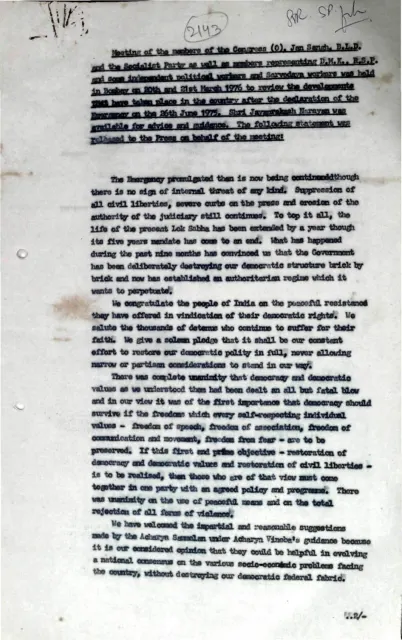
Meeting of the members of the Congress (O), Jan Sangh, B.L.D. and the Socialist Party as well as members representing D.M.K., R.S.P. and some independent political parties and Sarvodaya workers who held in Bombay on 20th and 21st March 1976 to review the developments that have taken place in the country after the declaration of the Emergency on the 26th June 1975. Shri Jayaprakash Narayan was unavailable for advice and guidance. The following statement was released to the Press on behalf of the meeting
Bombay · 1976
4 pages
Summary
This four-page English press statement records the position adopted at a Bombay meeting held on 20–21 March 1976 by representatives of Congress (O), Jan Sangh, the B.L.D., the Socialist Party, D.M.K., R.S.P., independent political groups, and Sarvodaya workers. The meeting reviews the consequences of the Emergency declared on 26 June 1975, arguing that the suspension of civil liberties, press censorship, and continuing erosion of judicial authority have transformed the Government into an authoritarian regime.
The statement congratulates public resistance, expresses solidarity with political detainees, and pledges to restore democratic politics without narrow or partisan considerations. It identifies freedom of speech, association, communication and movement, and freedom from fear as essential democratic freedoms; rejects violence; and calls for a unified democratic opposition. It also welcomes suggestions from the Acharya Sammelan under Acharya Vinoba’s guidance, provided that a national socio-economic consensus does not destroy India’s democratic federal structure. The second page establishes a four-member Steering Committee to formulate a programme for a single unified democratic opposition party and complete integration within two months. Pages 3 and 4 duplicate pages 1 and 2.
Key points
- The statement condemns the continuation of the Emergency without internal threat or justification.
- It cites suppression of civil liberties, severe press censorship, and erosion of judicial authority.
- It supports peaceful resistance and salutes detainees suffering for their faith in democracy.
- It defines freedom of speech, association, communication and movement, and freedom from fear as essential democratic freedoms.
- It calls for a unified democratic opposition committed to restoring democracy and civil liberties.
- It rejects all forms of violence and endorses peaceful political means.
- It welcomes the Acharya Sammelan’s socio-economic suggestions while insisting on preservation of India’s democratic federal structure.
- It creates a four-member Steering Committee tasked with designing and rapidly integrating a single opposition party.
Metadata and summary are AI-extracted from the source PDF and reviewed for editorial accuracy. The original work is available via the Read PDF tab above (where present); paragraph-level citation inside the PDF is deferred to a future engagement.