Summary
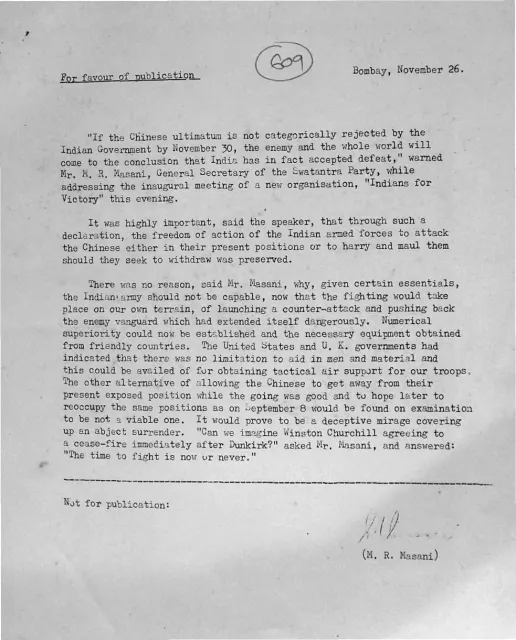
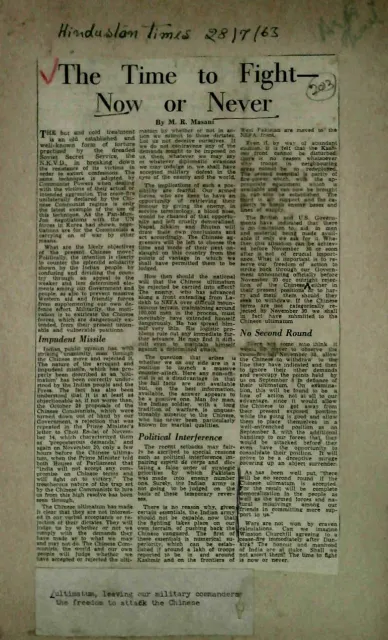
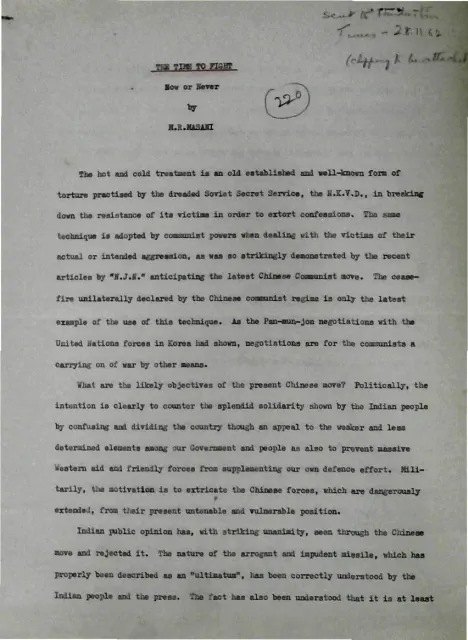
In the rendered pages, M. R. Masani argues that China’s cease-fire and ultimatum during the 1962 Sino-Indian conflict constitute a continuation of warfare by diplomatic means. He portrays the Chinese move as an attempt to divide Indian public opinion, discourage Western assistance, and extract Chinese forces from an exposed military position. India, he maintains, has correctly rejected the ultimatum and must judge that rejection by its actions rather than by diplomatic language alone.
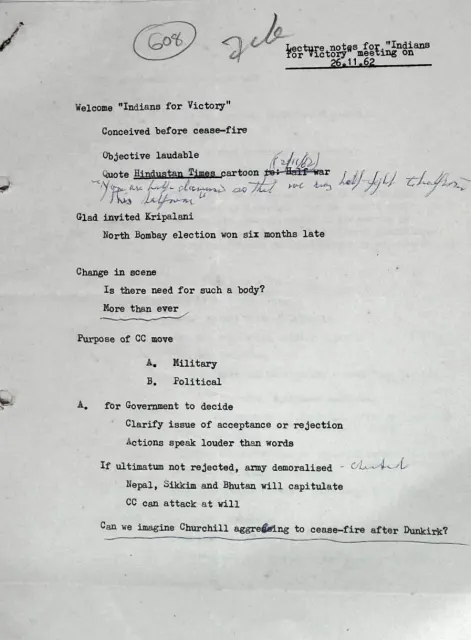
In the rendered pages, Masani urges the Government to reject the Chinese terms categorically and preserve the freedom of India’s military commanders to attack or pursue withdrawing Chinese forces. He argues that India can mount a counter-attack if it achieves numerical superiority, parity in firepower, and air support, and he calls for the redeployment of troops to the NEFA front. The essay closes by rejecting a cautious cease-fire strategy, invoking Winston Churchill’s conduct after Dunkirk, and presenting the conflict as a test of India’s honour and national will.
Key points
- Masani characterizes the Chinese cease-fire and ultimatum as a form of political and military coercion rather than a genuine peace initiative.
- He argues that the Chinese objective is to divide Indian opinion and prevent Western aid from strengthening India’s defence.
- He insists that India’s rejection of the ultimatum must be demonstrated through action and military resistance.
- He describes the Chinese forces as dangerously extended and vulnerable after advancing from Ladakh to NEFA.
- He identifies numerical superiority, parity of firepower, and air support as essentials for an Indian counter-attack.
- He opposes allowing Chinese forces to withdraw and consolidate their positions before India responds.
- He frames the decision as a matter of national honour, military morale, and India’s credibility with Nepal, Sikkim, Bhutan, and foreign supporters.
Metadata and summary are AI-extracted from the source PDF and reviewed for editorial accuracy. The original work is available via the Read PDF tab above (where present); paragraph-level citation inside the PDF is deferred to a future engagement.