Summary
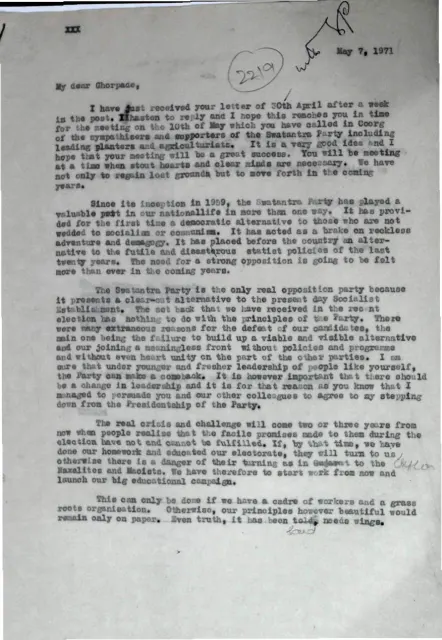
In this letter dated May 7, 1971, M. R. Masani writes to Rajkumar R. Ghorpade of the Swatantra Party’s Coorg Unit, encouraging a forthcoming meeting of party supporters, including planters and agriculturists. Masani presents the Swatantra Party, founded in 1959, as a necessary democratic alternative to socialism and communism, and credits it with resisting political adventurism and demagogy while offering an alternative to the prevailing Socialist Establishment.
Masani attributes the party’s recent electoral setback chiefly to its failure to build a visible alternative and to unite with other opposition parties around policies and programmes. He argues for younger leadership, explaining that he has agreed to step down as party president, and urges immediate political education and grassroots organisation. The letter closes by warning that voters may otherwise turn toward the Naxalites and Maoists when current electoral promises fail, and asks Ghorpade’s meeting to consider these issues and reach fruitful conclusions.
Key points
- Masani endorses a meeting of Swatantra Party supporters in Coorg, including leading planters and agriculturists.
- He describes the Swatantra Party as a democratic alternative to socialism and communism.
- He credits the party with opposing reckless political adventurism and demagogy.
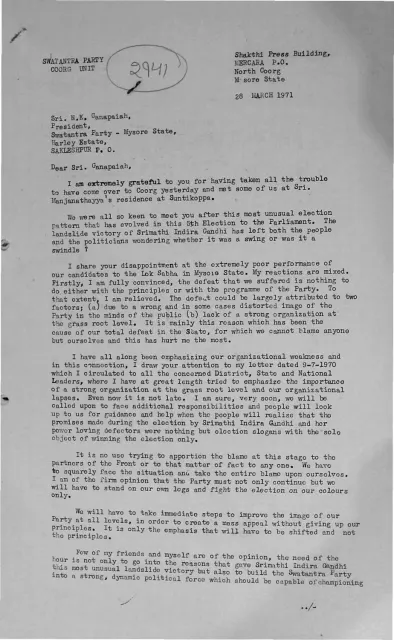
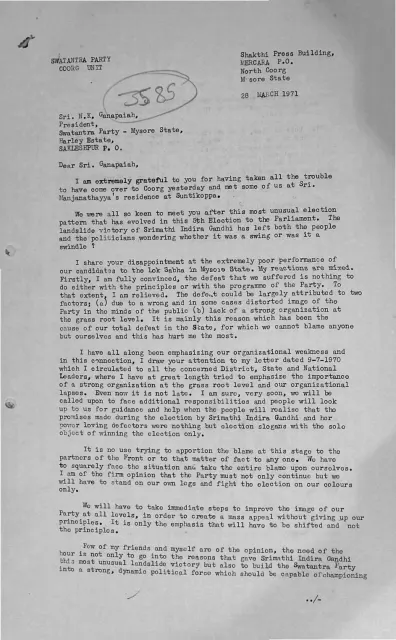
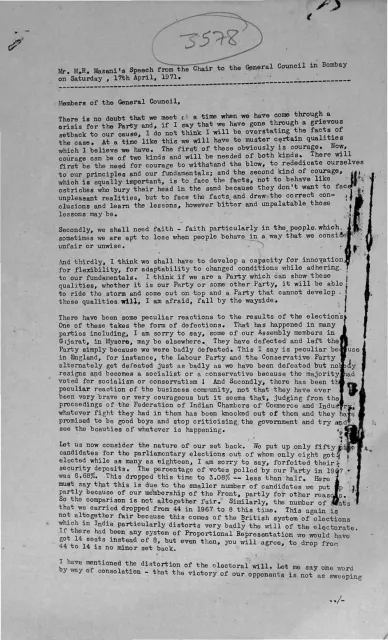
- He attributes the party’s recent electoral defeat to its failure to create a viable, visible alternative and to form effective opposition unity.
- He supports a transition to younger leadership and says he has agreed to step down as party president.
- He calls for political education, a cadre of workers, and a grassroots organisation before the next major electoral challenge.
- He warns that disappointed voters may turn toward Naxalites and Maoists.
Metadata and summary are AI-extracted from the source PDF and reviewed for editorial accuracy. The original work is available via the Read PDF tab above (where present); paragraph-level citation inside the PDF is deferred to a future engagement.