Summary
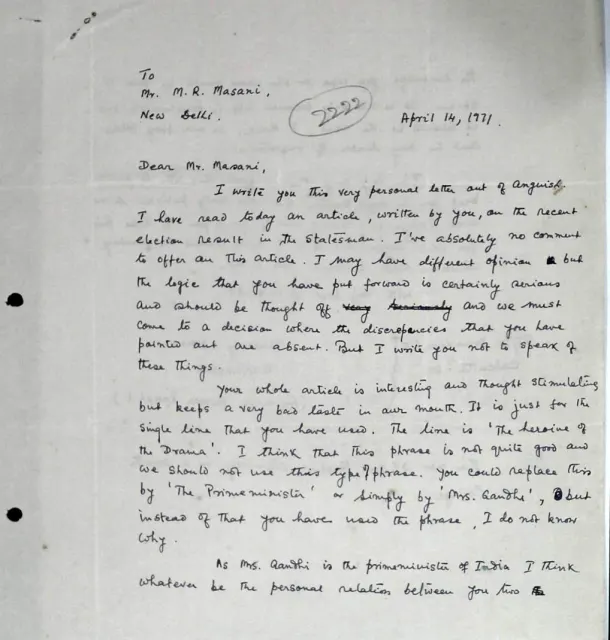
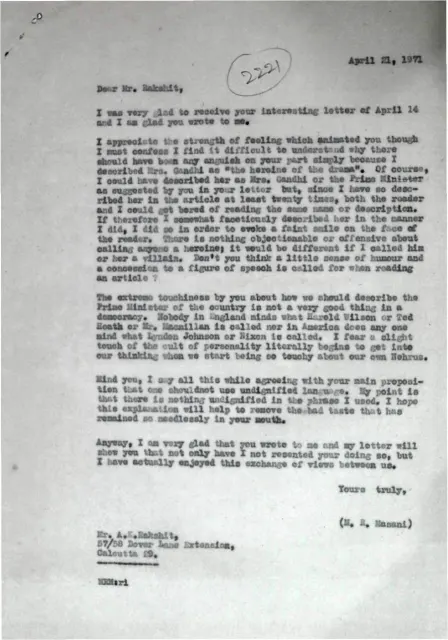
In this letter dated April 21, 1971, Minoo Masani replies to Mr. A. K. Rah… about the language used to describe Mahatma Gandhi and the Prime Minister. Masani says he understands the feeling behind the earlier letter but rejects the idea that describing Gandhi humorously or facetiously is inherently offensive, arguing that public figures need not be treated as heroes or villains beyond criticism or humour.
Masani broadens the point into a defence of democratic informality. He compares Indian sensitivity about political leaders with the ordinary naming and criticism of Harold Wilson, Ted Heath, Lyndon Johnson, and Nixon in England and the United States. While agreeing that “undignified language” should be avoided, he maintains that the phrase used in his article was not undignified and hopes the exchange has removed the bad taste left by the earlier wording.
Key points
- Masani acknowledges the emotional force of the recipient’s objection while questioning the basis for taking offence.
- He defends a facetious description of Mahatma Gandhi as an attempt to evoke a smile rather than to call him a hero or villain.
- He argues that excessive sensitivity toward a country’s Prime Minister is unhealthy in a democracy.
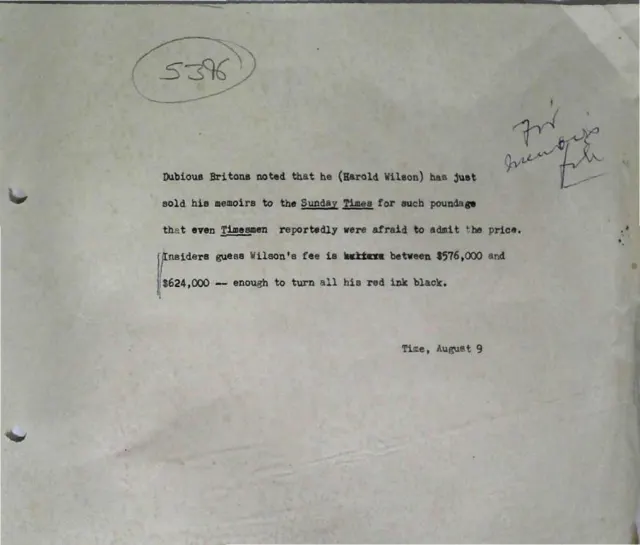
- He invokes ordinary public treatment of Harold Wilson, Ted Heath, Lyndon Johnson, and Nixon as comparative examples.
- He agrees that writers should avoid undignified language but denies that his own phrase was undignified.
- The letter closes by presenting the correspondence as a constructive exchange of views.
Metadata and summary are AI-extracted from the source PDF and reviewed for editorial accuracy. The original work is available via the Read PDF tab above (where present); paragraph-level citation inside the PDF is deferred to a future engagement.