
essay
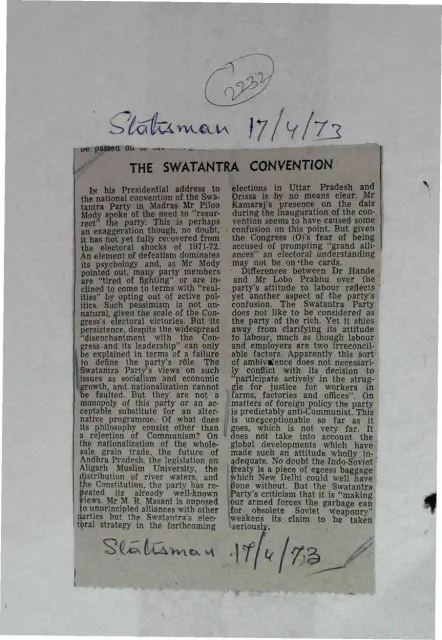
THE SWATANTRA CONVENTION
1973
1 pages
Summary
The editorial examines the Swatantra Party after its electoral setbacks in the 1971–72 elections, drawing on Piloo Mody’s presidential address to argue that the party has not fully recovered and that defeatism is shaping its internal psychology. It notes that some members are “tired of fighting” and inclined to withdraw from active politics, while contending that the party’s persistence cannot be explained solely by its “disenchantment with the Congress” or its leadership. The article also reviews Swatantra’s positions on socialism, economic growth, nationalisation, the Andhra Pradesh legislation, Aligarh Muslim University, river-water distribution, and the Constitution, while questioning whether these positions amount to an alternative programme beyond opposition to Communism.
The editorial identifies further confusion in the party’s electoral strategy and labour policy. It contrasts Minoo Masani’s opposition to unprincipled alliances with the party’s unclear approach to forthcoming elections in Uttar Pradesh and Orissa, and discusses the presence of Kamaraj at the convention’s inauguration. It also criticises the party’s attempt to combine a pro-rich identity with calls for active participation in workers’ struggles, and argues that its strongly anti-Communist response to the Indo-Soviet treaty reflects outdated Cold War assumptions rather than contemporary global developments.
Key points
- The Swatantra Party is portrayed as still recovering from the electoral shocks of 1971–72.
- The editorial links internal defeatism to members becoming “tired of fighting” and withdrawing from active politics.
- It reviews the party’s positions on socialism, economic growth, nationalisation, constitutional questions, and regional legislation.
- Minoo Masani’s opposition to unprincipled alliances is contrasted with uncertainty over the party’s electoral strategy in Uttar Pradesh and Orissa.
- The party’s labour policy is criticised as an uneasy combination of identification with the rich and support for workers’ struggles.
- Its opposition to the Indo-Soviet treaty is presented as excessively anti-Communist and insufficiently attentive to changing international conditions.
Metadata and summary are AI-extracted from the source PDF and reviewed for editorial accuracy. The original work is available via the Read PDF tab above (where present); paragraph-level citation inside the PDF is deferred to a future engagement.
Related across the archive
 Primary workSwatantra Party Men Urged To Aim High & Work Hard
 Primary workNeed To Resurrect Swatantra Party Stressed At Session
 Primary workSwatantra Newsletter
 OpinionMinoo Masani : From Socialism to Liberal Swatantra Party
 ThePrintHenry George’s Single Tax offers a democratic alternative to communist remedies: DM Kulkarni