essay
Challenging a Monopoly
Former AIR DG moves court to challenge Government's radio and TV monopoly.
Bombay · 1987
2 pages
Summary
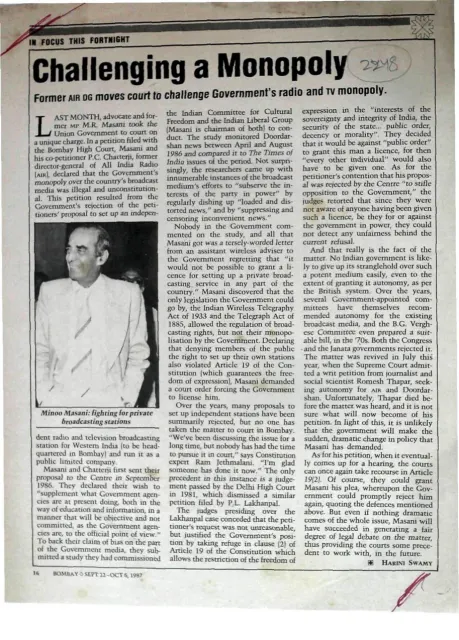
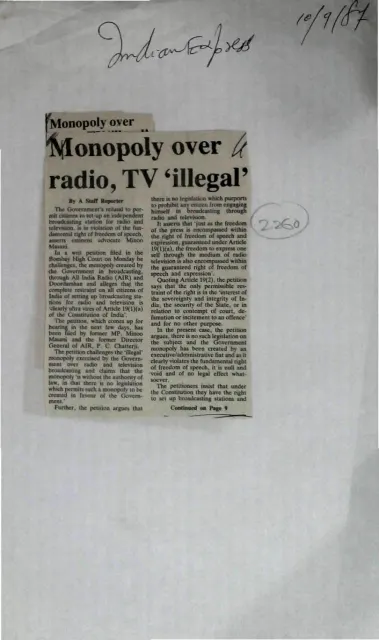
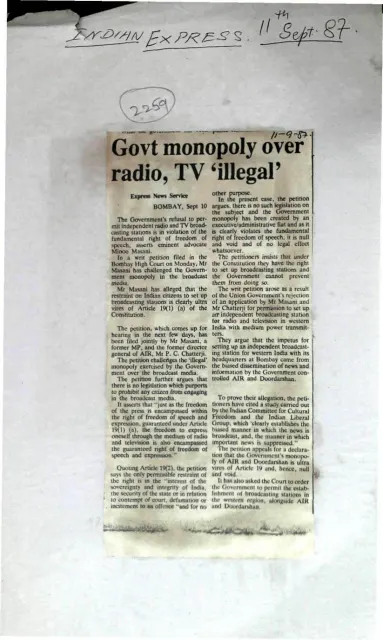
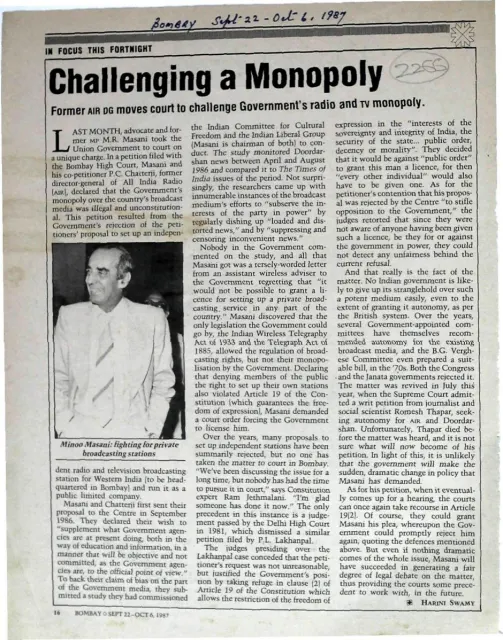
In this rendered article, Harini Swamy reports on M. R. Masani’s petition before the Bombay High Court challenging the Union Government’s monopoly over radio and television broadcasting. Masani, joined by former All India Radio director-general P. C. Chatterji, argues that the monopoly is illegal and unconstitutional, and asks the court to compel the Government to license a private broadcasting station. The petition invokes Article 19, especially freedom of expression, and contends that denying citizens the right to establish their own stations violates the Constitution.
The article places Masani’s case in the context of earlier proposals for autonomous broadcasting, including recommendations by government-appointed committees and a private bill prepared by the B. G. Verghese Committee. It describes the Government’s reliance on Article 19(2), including public order and state security, while noting that the judges questioned whether those grounds justified refusing a licence. The report concludes that the litigation may not immediately end the state’s control, but could generate useful legal debate and provide a precedent for future challenges.
Key points
- M. R. Masani and P. C. Chatterji petition the Bombay High Court against the Government’s radio and television broadcasting monopoly.
- The petition seeks a licence for a private broadcasting station and challenges the legality and constitutionality of the monopoly.
- Masani relies on Article 19 and argues that the denial of private broadcasting rights violates freedom of expression.
- The Government cites Article 19(2), including public order, state security, decency, and morality, as grounds for refusing a licence.
- The article recalls earlier recommendations for autonomous broadcasting and the rejection of a private bill prepared by the B. G. Verghese Committee.
- The judges reportedly found Masani’s request not unreasonable but did not immediately order the Government to issue a licence.
- The case is presented as potentially important for establishing a legal precedent and opening debate on broadcast autonomy.
Metadata and summary are AI-extracted from the source PDF and reviewed for editorial accuracy. The original work is available via the Read PDF tab above (where present); paragraph-level citation inside the PDF is deferred to a future engagement.