essay
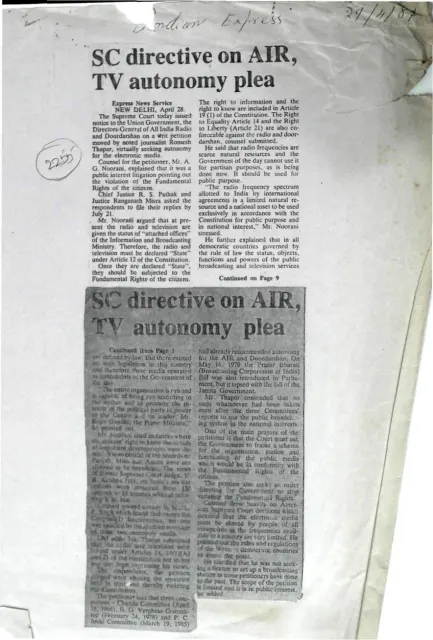
SC directive on AIR, TV autonomy plea
Indian Express · New Delhi · 1987
2 pages
Summary
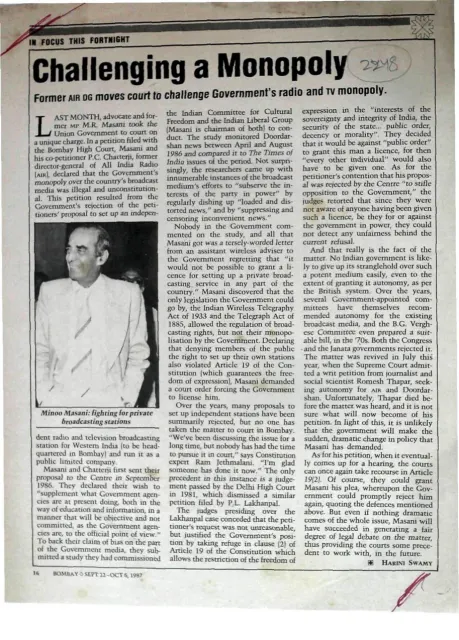
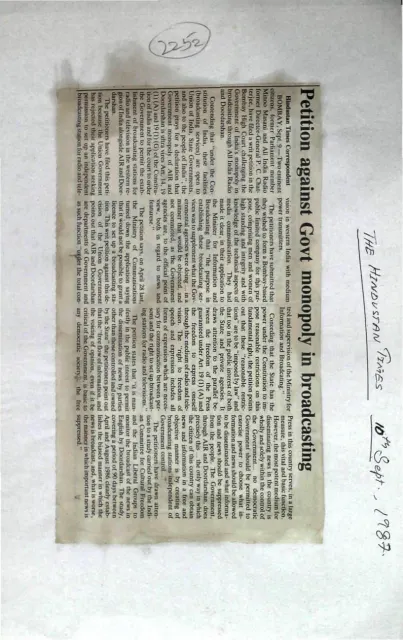
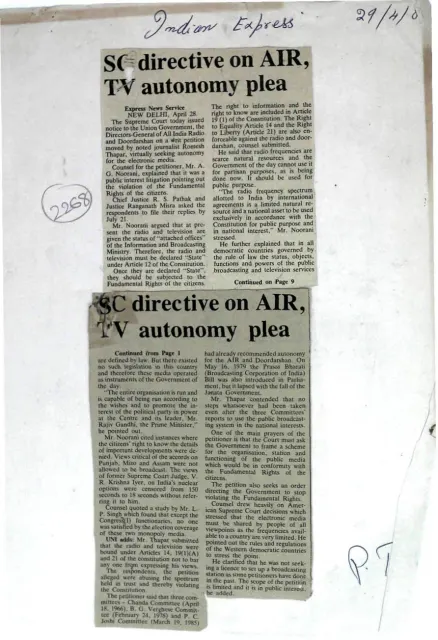
This two-page Indian Express report covers a Supreme Court hearing on a petition seeking autonomy for All India Radio and Doordarshan. Counsel G. Noorrani argued that the broadcasters should be treated as “State” under Article 12 of the Constitution and therefore subject to citizens’ Fundamental Rights, including the rights to information and equality. He maintained that radio frequencies are a limited natural resource and a national asset that must be used for public purposes rather than partisan ends.
The petition cites examples of alleged censorship and restricted broadcasting, including the non-telecast of views on Punjab, Mizoram and Assam and the cutting of V. R. Krishna Iyer’s nuclear-disarmament speech from 150 seconds to 18 seconds. It asks the Government to establish an autonomous broadcasting structure and to stop violating Fundamental Rights. The report also notes that earlier committees had recommended autonomy and that a Prasar Bharati Bill introduced in 1979 had lapsed with the fall of the Janata Government. The second clipping is a separate Express News Service report from Kottayam on Marxist leader E. M. S. Namboodiripad’s warning that Prime Minister Rajiv Gandhi might declare an Emergency; it is only partially visible and appears to continue beyond the rendered page.
Key points
- The Supreme Court issued notice to the Union Government in a petition seeking autonomy for All India Radio and Doordarshan.
- G. Noorrani argued that the broadcasters are effectively government-controlled offices and should qualify as “State” under Article 12.
- The petition links broadcasting autonomy to the constitutional rights to information, equality and freedom of speech.
- The report describes radio-frequency spectrum as a limited natural resource and national asset that should serve public purposes.
- Examples of alleged censorship include coverage of Punjab, Mizoram and Assam and the shortening of V. R. Krishna Iyer’s nuclear-disarmament speech.
- The petition seeks an autonomous broadcasting scheme and an order preventing further violations of Fundamental Rights.
- The report records earlier autonomy recommendations by the Chanda, B. G. Verghese and P. C. Joshi committees, as well as the lapse of the 1979 Prasar Bharati Bill.
- A partially visible second report records E. M. S. Namboodiripad’s warning that Rajiv Gandhi might declare an Emergency and his call for opposition unity.
Metadata and summary are AI-extracted from the source PDF and reviewed for editorial accuracy. The original work is available via the Read PDF tab above (where present); paragraph-level citation inside the PDF is deferred to a future engagement.