
speech · convention address
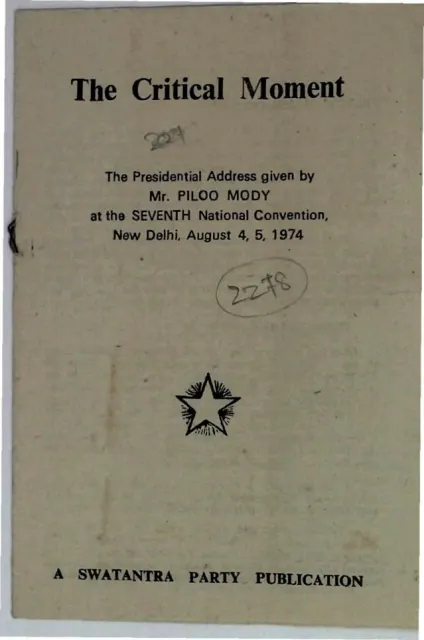
The Critical Moment
Published by V. P. Bhatia, Executive Secretary, Swatantra Party, National Headquarters, 143 Mahatma Gandhi Road, Bombay 400 001 and printed by Naranda Press, D-39, NDSE, Part I New Delhi-110049 · Bombay · 1974
12 pages
Summary
In this presidential address to the Swatantra Party’s Seventh National Convention, Piloo Mody presents India as facing a decisive political crisis. He argues that rising prices, unemployment, shortages, corruption, injustice, and the deterioration of democratic institutions have produced public anger, particularly visible in Gujarat and Bihar. Mody attributes the crisis chiefly to the Congress government’s refusal to reform the electoral process, its use of money and state-controlled media, and its tendency to blame opposition parties and foreign agencies rather than accept responsibility. He insists that analysis must lead to action, and recounts his own extensive touring, lobbying, and public advocacy on behalf of the party’s programme.
The address endorses a practical programme: build a national party cadre, educate government officials toward pragmatic administration, fight corruption, pursue a two-party system, and secure basic electoral reform. Mody calls for cooperation with Jayaprakash Narayan’s movement while warning against surrendering politics to extremists or dictators. The central decision before the convention is whether the Swatantra Party should preserve its name and organizational identity or merge into a larger National Alternative. Mody acknowledges the personal and institutional costs of merger but concludes that it would represent not the party’s dissolution, but its transformation into a broader democratic struggle.
Key points
- Mody frames 1974 as a critical moment in which India’s democratic and constitutional order is at stake.
- He attributes public unrest to economic hardship, governmental failure, corruption, and the loss of legitimate channels for political protest.
- The address sharply criticizes electoral malpractices, including gerrymandering, communal polarization, money power, controlled media, intimidation, and alleged vote manipulation.
- Mody argues that the Swatantra Party must combine political analysis with organized action rather than merely pass resolutions.
- He proposes cadre-building, political education, anti-corruption measures, electoral reform, and the creation of a two-party system.
- He supports cooperation with Jayaprakash Narayan’s movement but rejects passivity, extremism, and dictatorship from either the left or the right.
- The convention is asked to decide whether Swatantra should merge into a National Alternative while retaining its ideological commitments.
Metadata and summary are AI-extracted from the source PDF and reviewed for editorial accuracy. The original work is available via the Read PDF tab above (where present); paragraph-level citation inside the PDF is deferred to a future engagement.
Related across the archive
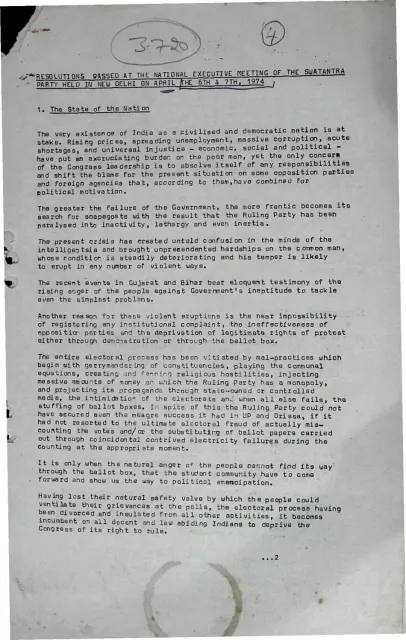 Primary workRESOLUTIONS PASSED AT THE NATIONAL EXCUTIVE MEETING OF THE SWATANTRA PARTY HELD IN NEW DELHI ON APRIL THE 6TH & 7TH, 1974
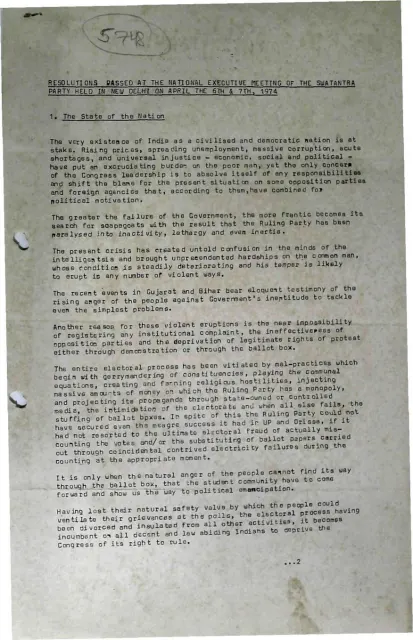 Primary workRESOLUTIONS PASSED AT THE NATIONAL EXECUTIVE MEETING OF THE SWATANTRA PARTY HELD IN NEW DELHI ON APRIL THE 6TH & 7TH, 1974
 ExcerptManifesto for Indian Liberals
 ExcerptPanchayati Raj