legal filing · report
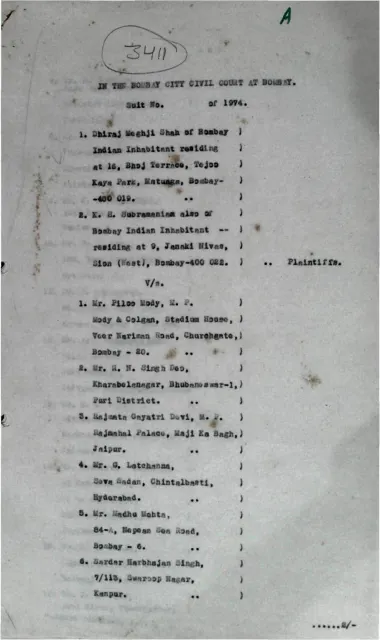
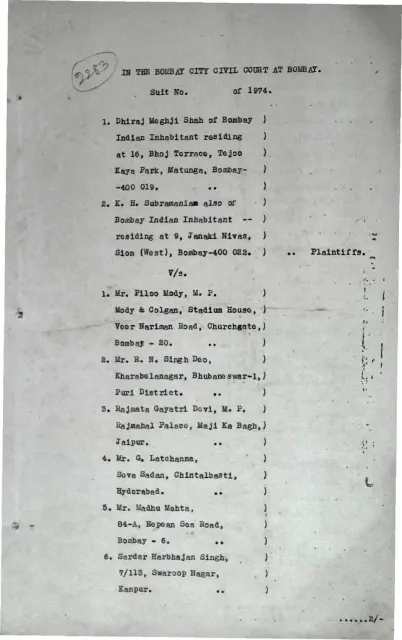
In The Bombay City Civil Court At Bombay
Bombay · 1974
31 pages
Summary
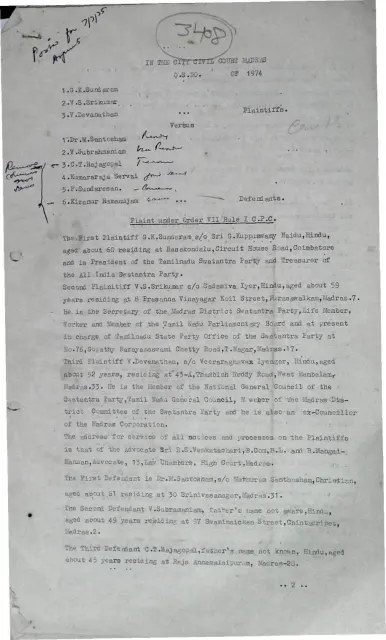
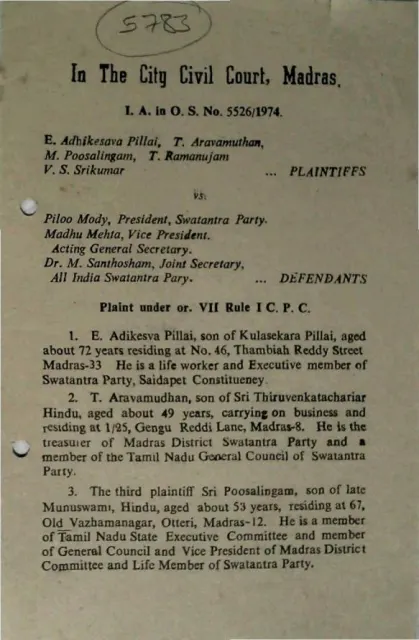
This 1974 civil-court plaint concerns an internal political and organisational dispute surrounding the dissolution of the Swatantra Party and the proposed formation of the Bharatiya Lok Dal. The plaintiffs identify themselves and defendants 1–32 as members or former office-bearers of the Swatantra Party, while defendants 1 and 33 onward are described as office-bearers of the new party formed on 29 August 1974. The pleading sets out the Swatantra Party’s origins in 1959, its statement of principles, its constitution, its organisational hierarchy, membership rules, financial arrangements, disciplinary procedures, and authority to raise and administer funds.
The pages argue that the Swatantra Party possessed a distinctive philosophical identity and that its assets, offices, funds, and organisational units were held for the furtherance of its stated objectives. They recount the party’s 1974 discussions about a national alternative and a two-party system, including a proposed programme stressing democracy, nationalism, socialism, social justice, decentralisation, and economic and administrative reform. The plaintiffs contend that a programme-based proposed new party lacked the Swatantra Party’s ideological foundation, and that the Maharashtra State Council opposed dissolving Swatantra before the matter had been reconsidered by the party’s General Council and National Convention. The rendered pages end during the account of the July 1974 Maharashtra meeting; the court’s decision and the remainder of the pleading are not visible.
Key points
- The plaint is filed in the Bombay City Civil Court in a 1974 suit involving Swatantra Party members and office-bearers.
- It distinguishes the Swatantra Party, founded in 1959, from the Bharatiya Lok Dal, formed on 29 August 1974.
- The pleading treats the Swatantra Party’s statement of principles and constitution as the basis of its political identity.
- The party constitution described here establishes primary, district, state or regional, general-council, and national-executive bodies.
- Membership, subscriptions, financial allocation, disciplinary powers, appeals, elections, conventions, and constitutional amendments are described in detail.
- The plaintiffs claim that party units acquired assets, funds, premises, and bank accounts for Swatantra Party objectives.
- The 1974 programme promoted cadre-building, administrative efficiency, anti-corruption, a two-party system, and cooperation among non-Congress parties.
- The Maharashtra State Council is described as opposing dissolution of the Swatantra Party pending further consideration by the General Council and National Convention.
Metadata and summary are AI-extracted from the source PDF and reviewed for editorial accuracy. The original work is available via the Read PDF tab above (where present); paragraph-level citation inside the PDF is deferred to a future engagement.