speech
Speech of Mr Minoo Masani
1962
4 pages
Summary
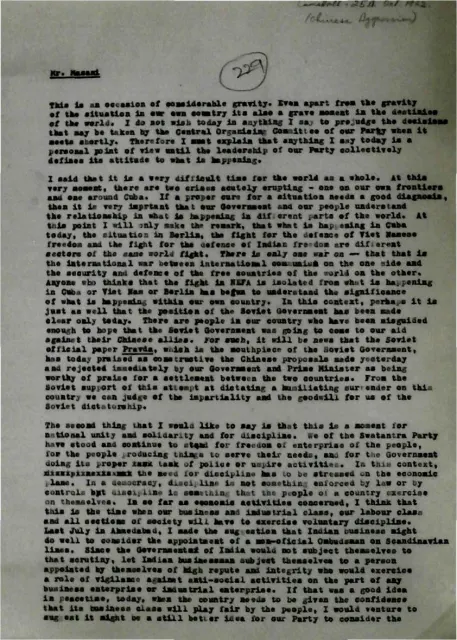
This four-page English speech, headed “Mr. Masani,” argues that India’s response to the international crises of the early 1960s must combine military preparedness with democratic discipline and political unity. The speaker links the fighting in Cuba, Berlin, Vietnam, and on India’s frontier, insisting that the conflict with Chinese communism is part of a wider struggle between international communism and the security of free countries. He sharply criticizes the government’s handling of Tibet, its rejection of military assistance, and its decision to pursue diplomatic accommodation with China while Indian troops remain inadequately equipped.
The speech distinguishes democratic national unity from totalitarian unanimity. Masani uses Britain’s wartime coalition government as an example of how a country can support the war effort while preserving a vigorous opposition, and he calls for unconditional support for policies that defend India without requiring citizens to abandon criticism. He also advocates greater public and institutional discipline, including an ombudsman or independent vigilante mechanism for business and industry, and concludes by demanding a change in foreign and defence policy. The manuscript provides no printed title, venue, date, or publication information; the filename is not treated as evidence for the date.
Key points
- The speech frames the India-China conflict as part of a broader international struggle involving communism and the security of free countries.
- It argues that the crises in Cuba, Berlin, Vietnam, Tibet, and India should not be treated as isolated events.
- The speaker criticizes the government for rejecting an offer of automatic weapons and for leaving Indian forces inadequately armed.
- It calls for national unity and discipline while defending the right of democratic citizens and parties to criticize government policy.
- Britain’s wartime coalition is presented as an example of loyal opposition operating within a national war effort.
- The speech proposes independent oversight of business and industrial conduct through an ombudsman-like institution.
- It urges the government to seek assistance from other countries and to adopt a more active policy toward China.
Metadata and summary are AI-extracted from the source PDF and reviewed for editorial accuracy. The original work is available via the Read PDF tab above (where present); paragraph-level citation inside the PDF is deferred to a future engagement.