essay
Heresies About The Constitution
The Times of India · 1987
2 pages
Summary
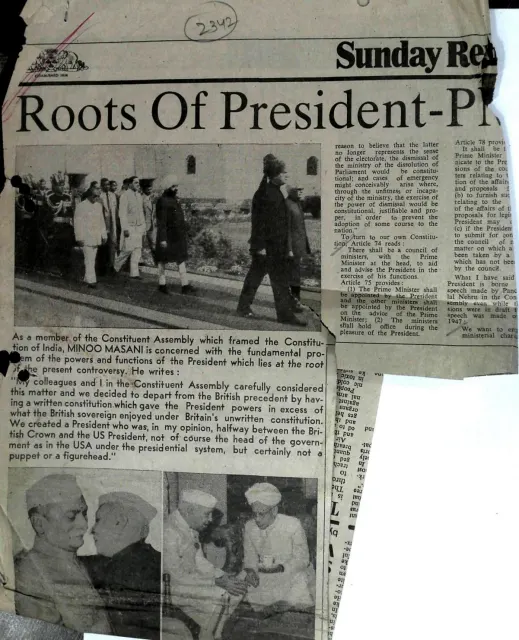
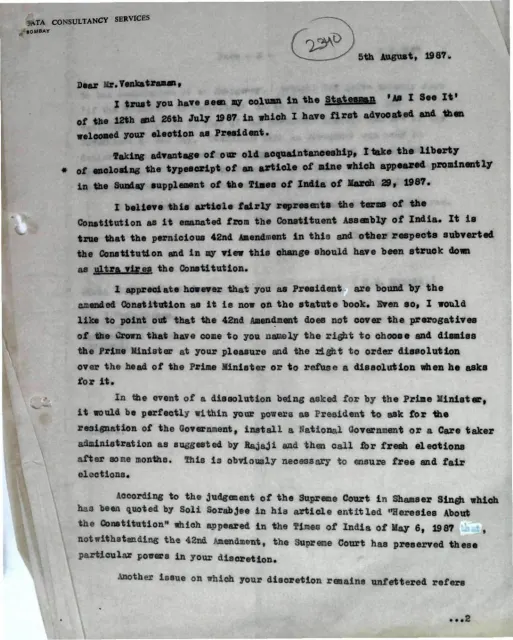
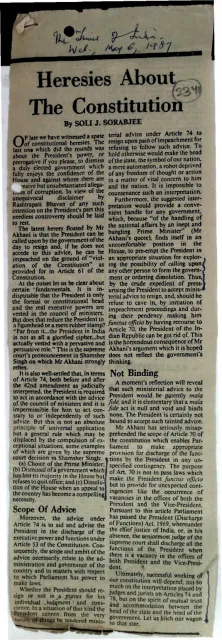
In the rendered first page, Soli J. Sorabjee responds to what he calls a recent “spate of constitutional heresies,” focusing on the claim that the President can be compelled by the Prime Minister or government to resign and can be impeached for refusing ministerial advice. Sorabjee distinguishes the President’s formal constitutional position from the real executive power exercised by ministers, while arguing that Article 74 does not eliminate the President’s discretion in every conceivable circumstance. He invokes the Supreme Court’s decision in Shamsher Singh to acknowledge the general rule that the President acts on ministerial advice, but stresses that exceptional situations—such as a Prime Minister losing majority support, refusing to resign, or the dissolution of the Lok Sabha becoming necessary—cannot be reduced to a rigid formula.
The article argues that ministerial advice under Article 74 concerns the discharge of executive functions under Article 53 and therefore relates to the administration and governance of the country, not to every matter on which Parliament may legislate. Sorabjee rejects the proposed use of impeachment as a way to force compliance, describing ministerial advice to resign as mala fide and legally void if it were designed to manipulate Articles 70 and 74. He closes by urging interpretation of the Constitution in a spirit of mutual trust and accommodation between the head of state and the government.
Key points
- Sorabjee challenges the claim that the President may be forced to resign for refusing ministerial advice.
- He accepts the general principle that the President acts on the advice of the Council of Ministers but rejects its universal application.
- He identifies exceptional situations involving a Prime Minister’s loss of majority, refusal to resign, or necessary dissolution of the Lok Sabha.
- Article 74 advice, he argues, concerns executive functions and governance rather than every subject on which Parliament can legislate.
- He contends that mala fide advice to resign would be null and void and could not bind the President.
- He warns that using impeachment proceedings to compel resignation would undermine the constitutional position of the President.
- The article relies on the Supreme Court’s reasoning in Shamsher Singh and advocates constitutional interpretation grounded in trust and accommodation.
Metadata and summary are AI-extracted from the source PDF and reviewed for editorial accuracy. The original work is available via the Read PDF tab above (where present); paragraph-level citation inside the PDF is deferred to a future engagement.