press note · position paper
For Favour of Publication
Swatantra Party · New Delhi · 1962
2 pages
Summary
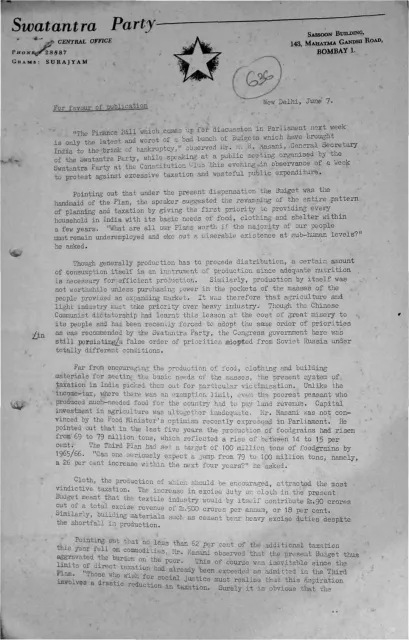
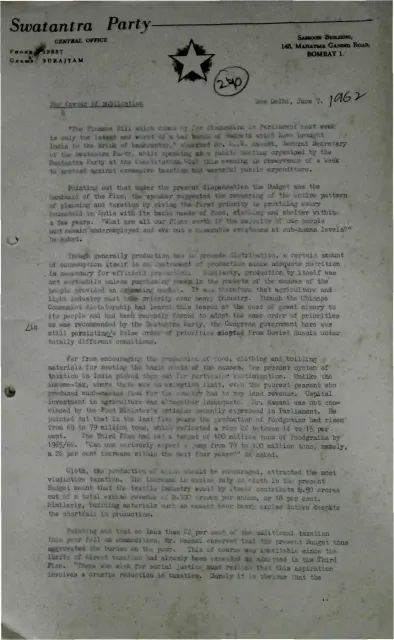
This two-page Swatantra Party press note, issued from New Delhi on 7 June 1962 and signed by General Secretary M. R. Masani, attacks the Union Budget as an extension of the planning system and as an additional burden on the poor. It argues that economic policy should first secure every household’s basic needs—food, clothing, and shelter—rather than pursue an abstract industrial pattern. The statement gives priority to agriculture and light industry, criticising the government’s continued emphasis on heavy industry under conditions unlike those in countries such as China and Soviet Russia.
The note challenges the Budget’s tax burden, agricultural neglect, and excise policy. It cites foodgrain production rising from 69 to 79 million tons in five years while questioning the Third Plan’s target of 100 million tons by 1965–66. It also argues that textile excise duties would reduce production and that taxation falling mainly on the poor is incompatible with social justice. Masani concludes by calling for abolition of land revenue, reduced duties on essential raw materials and intermediates, lower corporate and income-tax rates, fiscal restraint, and expenditure cuts aimed at limiting bureaucratic expansion.
Key points
- The statement presents the Swatantra Party’s criticism of the Union Budget of 1962.
- It treats the Budget as a continuation of planning and argues that policy should begin with universal access to food, clothing, and shelter.
- It recommends giving agriculture and light industry priority over heavy industry.
- It questions whether the Third Plan’s foodgrain target of 100 million tons by 1965–66 is realistic.
- It criticises taxation and excise duties for burdening the poor and discouraging textile production.
- It calls for abolition of land revenue, reduced taxation, fiscal discipline, and limits on bureaucratic growth.
Metadata and summary are AI-extracted from the source PDF and reviewed for editorial accuracy. The original work is available via the Read PDF tab above (where present); paragraph-level citation inside the PDF is deferred to a future engagement.