essay · working paper
Swatantra Party and International Questions:
2 pages
Summary
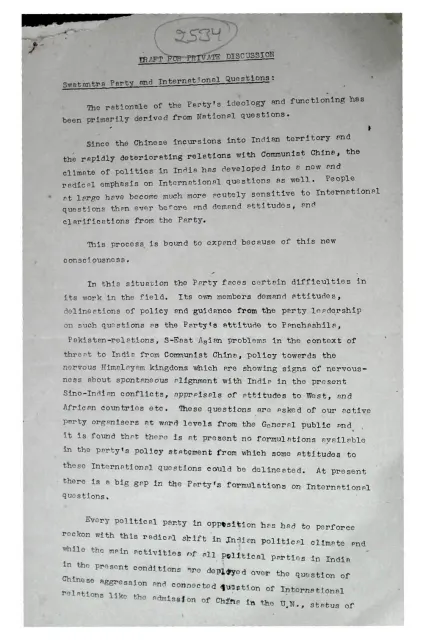
This two-page draft for private discussion argues that the Swatantra Party must formulate a clear position on international questions. It attributes the growing importance of foreign policy to Chinese incursions into Indian territory and worsening relations with Communist China, noting that public opinion and party members increasingly demand guidance on Panchsheel, Pakistan, Southeast Asia, the Himalayan kingdoms, Western countries, and African states.
The draft identifies a gap between the Party’s clear positions on fundamental national questions and its silence on international issues. This silence, it argues, has weakened the work of party members and organizers, dissipated public support, and created the appearance of a “split personality.” The author asks the Party’s National Executive to address the problem promptly because it affects organizational work, particularly in urban areas where political consciousness among the party’s middle-class base is highly developed. The document is signed “S.R. Mohan Das.”
Key points
- The Swatantra Party’s ideology and functioning are said to have been shaped primarily by national questions, leaving international questions insufficiently formulated.
- Chinese incursions and deteriorating relations with Communist China have heightened public sensitivity to foreign-policy issues.
- Party members and the public seek guidance on Panchsheel, Pakistan, Southeast Asia, the Himalayan kingdoms, Western countries, and African countries.
- The Party’s reluctance to comment for fear of violating foreign-policy statements has damaged the effectiveness of its field organization.
- The contrast between clarity on national questions and silence on international questions presents the Party as having a “split personality.”
- The draft calls for immediate National Executive consideration, especially because the problem is acute in urban units and affects organizational work.
Metadata and summary are AI-extracted from the source PDF and reviewed for editorial accuracy. The original work is available via the Read PDF tab above (where present); paragraph-level citation inside the PDF is deferred to a future engagement.