speech
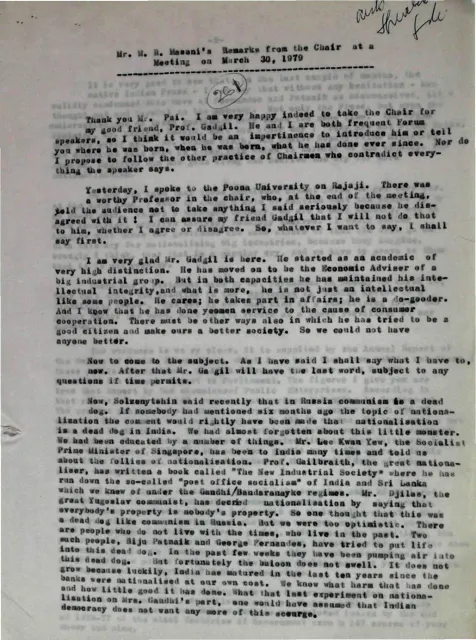
Mr. M. R. Masani's Remarks from the Chair at a Meeting on March 30, 1979
1979
2 pages
Summary
In these two pages of remarks delivered from the chair on March 30, 1979, M. R. Masani introduces Professor Gadgil and then turns to the question of nationalisation. He argues that the failures of Indian public enterprises were already evident from earlier warnings by Lee Kuan Yew, John Kenneth Galbraith, Milovan Djilas, and others, and contends that attempts to revive nationalisation represent an effort to breathe life into a failed model. The speech contrasts public-sector inefficiency with the presumed discipline of private enterprise and stresses the costs imposed on taxpayers and consumers.
Masani supports what he calls denationalisation, or “privatisation” in the terminology used abroad. Drawing on Indira Gandhi’s earlier description of public-enterprise failures, he cites falling capacity utilisation, extensive industrial unrest, overcapitalisation, overstaffing, weak work-study, poor financial controls, inadequate personnel policy, cost escalation, and delays. He concludes that the immediate policy agenda should be to consider returning enterprises to private ownership rather than expanding nationalisation. The document contains the complete two-page speech as rendered; no venue, publisher, or wider meeting context is visible.
Key points
- Masani praises Professor Gadgil’s intellectual integrity and public service before introducing the subject of nationalisation.
- The speech presents nationalisation as a failed policy whose weaknesses had been identified by several earlier critics.
- It cites declining capacity utilisation and widespread strikes as evidence of public-sector deterioration.
- Indira Gandhi’s 1965 description of public-enterprise defects is used to support the critique.
- The listed problems include overcapitalisation, overstaffing, inadequate work-study, weak financial control, cost escalation, and delays.
- Masani argues that taxpayers continue to finance enterprises that would otherwise have become bankrupt.
- He advocates denationalisation and considers transferring public enterprises to shareholders or private management.
Metadata and summary are AI-extracted from the source PDF and reviewed for editorial accuracy. The original work is available via the Read PDF tab above (where present); paragraph-level citation inside the PDF is deferred to a future engagement.