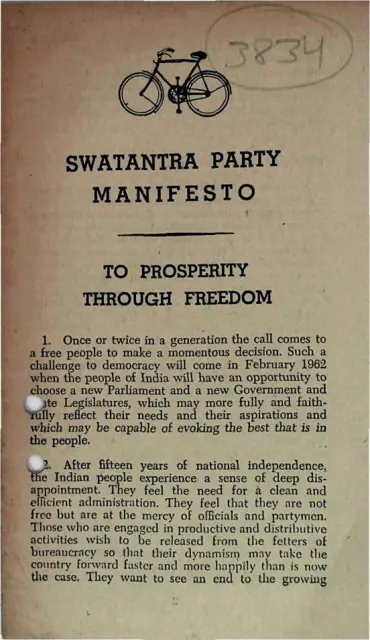
press note
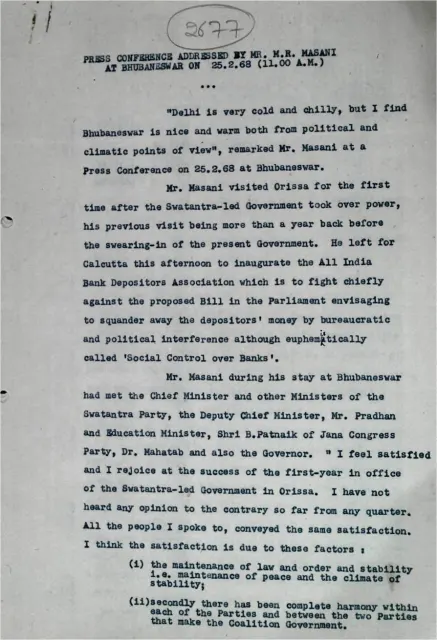
PRESS CONFERENCE ADDRESSED BY MR. M.R. MASANI AT BHUBANESWAR ON 25.2.68 (11.00 A.M.)
By Minoo Masani
Bhubaneswar · 1968
13 pages
Summary
This 13-page English transcript records Minoo Masani’s press conference in Bhubaneswar on 25 February 1968. Masani praises the first year of the Swatantra-led coalition government in Orissa, attributing public satisfaction to law and order, political stability, harmony among coalition partners, and an honest effort to clean up administration. He urges wider national publicity for what he presents as a successful alternative to developments in West Bengal, Bihar, and Uttar Pradesh, and links good government to democratic accountability rather than party control of ministers.
The discussion ranges across religious freedom, bank depositors’ opposition to proposed “Social Control over Banks,” industrial investment, prohibition, labour organisation, Communist politics, party alliances, language policy, rice controls, subsidies, fiscal restraint, and national government. Masani defends minority rights while warning against laws that could impair constitutional protection for religious propagation; supports private investment, free markets, agricultural incentives, transparent subsidies, and reduced unproductive expenditure; and argues that language should remain a matter of individual and parental choice rather than political control. He also advocates a government of “Democratic Unity,” while insisting that banning political parties should be exceptional and justified by circumstances. The transcript ends with comments on land-revenue abolition and implementation of the Kutch Award.
Key points
- Masani presents Orissa’s Swatantra-led coalition government as stable, relatively honest, and administratively reforming.
- He argues that public confidence rests on law and order, coalition harmony, and a sincere attempt to provide good government.
- He defends minority rights and raises concerns that religious-conversion legislation might impair constitutional rights to propagate religion.
- He supports attracting domestic and foreign capital to Orissa, removing zonal barriers, and allowing freer markets.
- He proposes a non-partisan, advisory relationship between the Swatantra Party and trade unions rather than attempts to capture them.
- He calls for exceptional rather than routine bans on political parties, while advocating action against Communist influence in West Bengal.
- He treats language choice as a matter for teachers, parents, and children, opposing political interference in the medium of instruction.
- He advocates agricultural incentives, fairer producer prices, transparent subsidies, fiscal retrenchment, and a national government based on democratic unity.
Metadata and summary are AI-extracted from the source PDF and reviewed for editorial accuracy. The original work is available via the Read PDF tab above (where present); paragraph-level citation inside the PDF is deferred to a future engagement.