essay
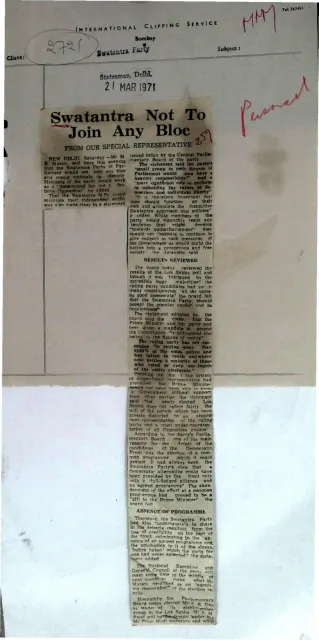
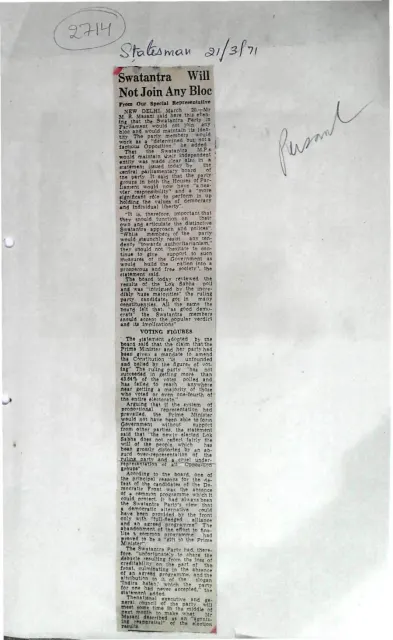
Swatantra Will Not Join Any Bloc
Statesman · New Delhi · 1971
1 pages
Summary
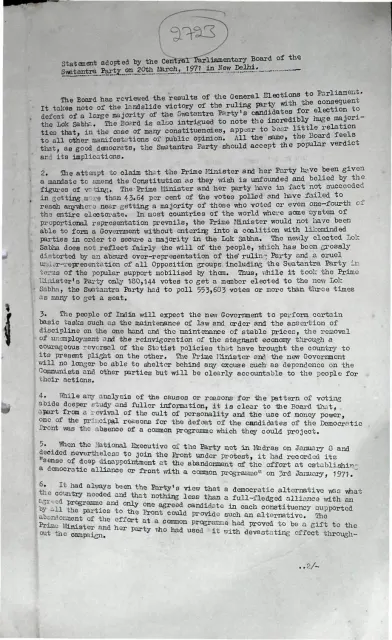
This newspaper report from New Delhi records the Swatantra Party’s decision not to join any parliamentary bloc after the 1971 Lok Sabha election. M. R. Masani is quoted as saying that the party would preserve its independent identity and function as a “determined but not a factious opposition.” The party’s board also argued that opposition groups had a responsibility to offer a more significant alternative while defending democracy and individual liberty, supporting government measures that could build a prosperous and free society while resisting authoritarian tendencies.
The report further presents the party’s criticism of the election outcome and the first-past-the-post system. It says the ruling party’s vote share did not amount to a majority of votes cast, and argues that proportional representation would have produced a government dependent on support from other parties. The Swatantra board attributed the opposition’s electoral failure partly to the absence of a common programme and urged a future “full-fledged alliance” with an agreed programme rather than a merely common anti-government front. The clipping is credited only to “Our Special Representative”; no personal author is named.
Key points
- The Swatantra Party decided to remain independent in Parliament and not join any bloc.
- M. R. Masani presented the party as a determined but non-factional opposition.
- The party claimed that opposition groups should defend democracy and individual liberty while supporting constructive government measures.
- The report criticises the ruling party’s electoral mandate by distinguishing a parliamentary majority from a majority of votes cast or of the total electorate.
- The Swatantra board argued that proportional representation would have produced a government reliant on inter-party support.
- The party attributed opposition losses to the absence of a common programme and proposed a future full-fledged alliance.
Metadata and summary are AI-extracted from the source PDF and reviewed for editorial accuracy. The original work is available via the Read PDF tab above (where present); paragraph-level citation inside the PDF is deferred to a future engagement.