essay
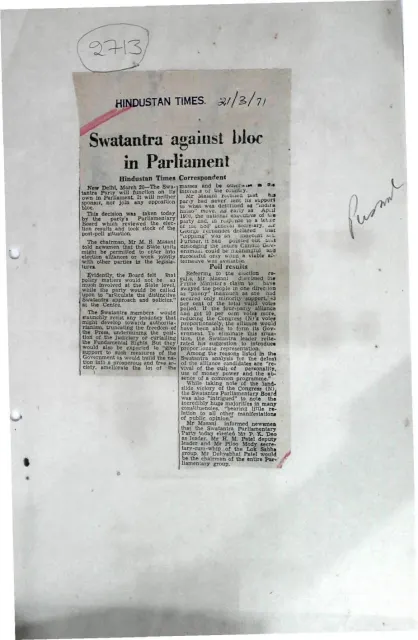
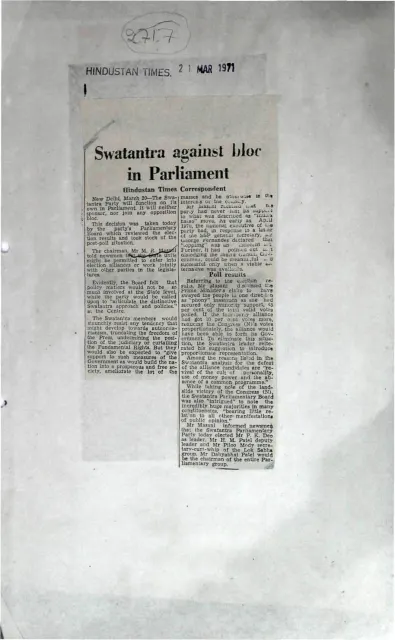
Swatantra against bloc in Parliament
HINDUSTAN TIMES · New Delhi · 1971
1 pages
Summary
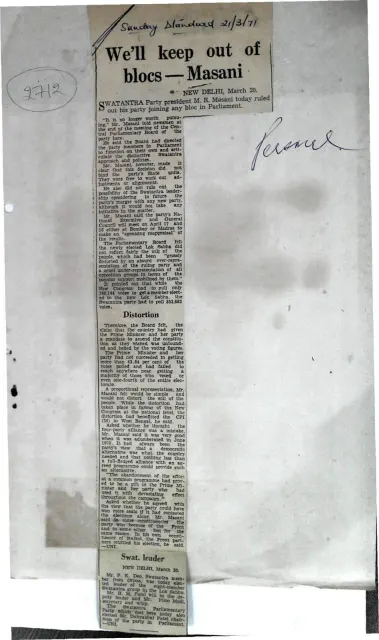
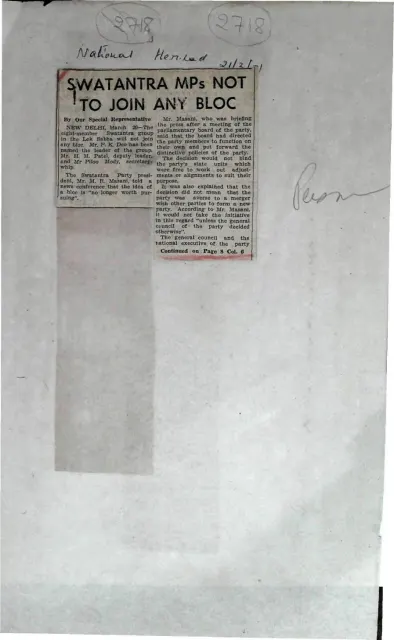
This 21 March 1971 Hindustan Times report describes the Swatantra Party’s decision to operate independently in Parliament rather than sponsor or join an opposition bloc. Party chairman Minoo Masani said that elected members would not be permitted to enter electoral alliances or work jointly with other parties in the legislature. The party would instead present a distinctive Swatantra programme at the national level, while remaining open to issue-based support for measures that could improve social and economic conditions.
The report presents the party’s parliamentary stance as a defence of individual freedom and constitutional safeguards. It says Swatantra members would resist authoritarian tendencies, restrictions on the press, and curtailment of fundamental rights, while supporting measures aimed at a prosperous and free society. Masani attributed the party’s electoral defeat to the personality-based revival of the Congress, the use of money, and the absence of a common programme; he renewed his call for proportional representation. The article also records the party’s post-election parliamentary leadership: H. M. Patel as leader, Piloo Mody as deputy leader and secretary-cum-whip, and Dahyabhai Patel as chairman of the parliamentary group.
Key points
- The Swatantra Party decided to function independently in Parliament and not join an opposition bloc.
- Its members were not to enter electoral alliances or cooperate jointly with other parties in the legislature.
- Minoo Masani said the party would articulate a distinct Swatantra approach and policy at the Centre.
- The party’s stated parliamentary concerns included resistance to authoritarianism, press restrictions, and curtailment of fundamental rights.
- The report attributes Swatantra’s electoral defeat to personality-based politics, money, and the absence of a common programme.
- Masani reiterated support for proportional representation as a remedy for the electoral situation.
- H. M. Patel, Piloo Mody, and Dahyabhai Patel were identified as parliamentary leaders.
Metadata and summary are AI-extracted from the source PDF and reviewed for editorial accuracy. The original work is available via the Read PDF tab above (where present); paragraph-level citation inside the PDF is deferred to a future engagement.