Summary
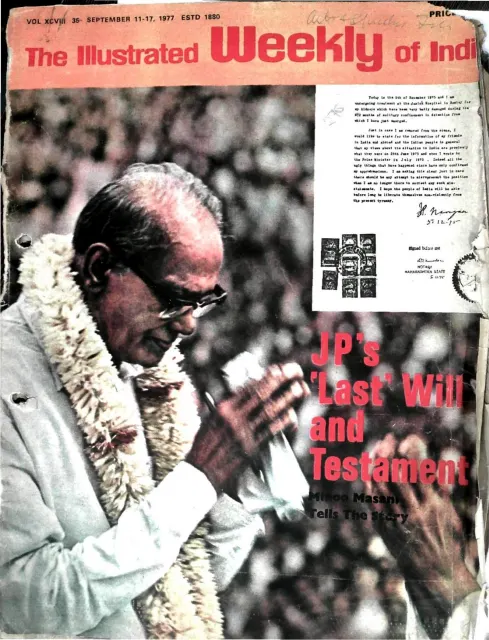
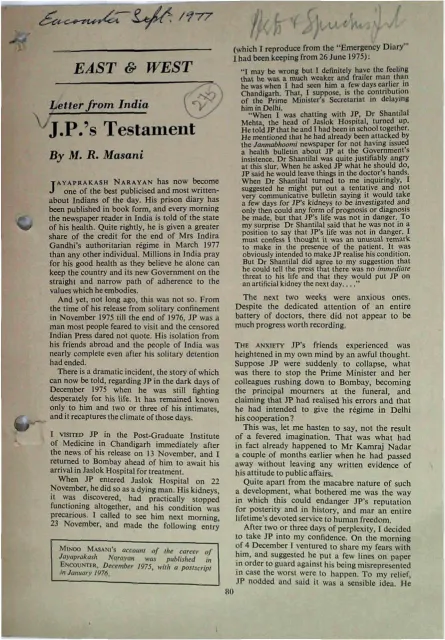
In “J.P.’s Testament,” M. R. Masani recounts Jayaprakash Narayan’s critical illness after his release from solitary confinement during the Emergency and explains how the experience prompted him to prepare a political testament. Masani describes JP’s deteriorating condition, the anxiety of friends who feared that his death might be exploited by the government, and his concern that the regime could falsely claim that he had changed his political position and agreed to cooperate with Prime Minister Indira Gandhi.
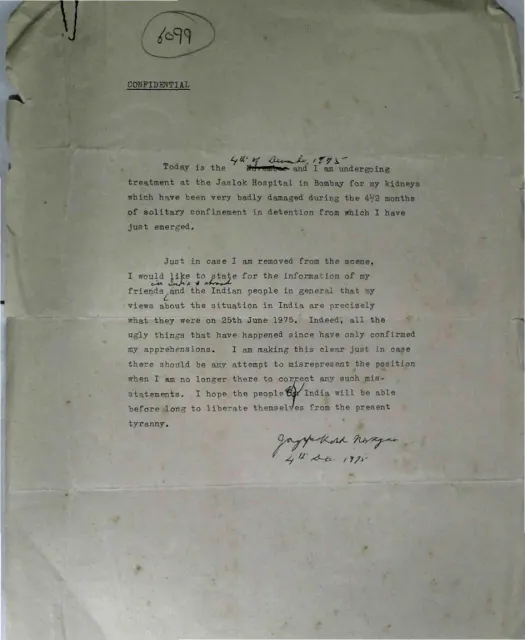
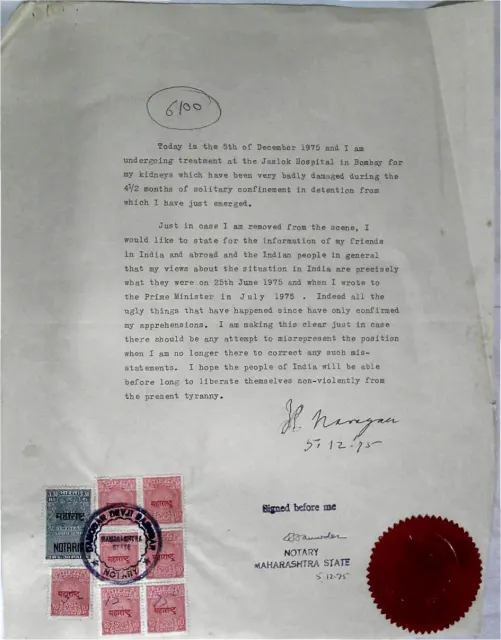
Masani then narrates the drafting and formal notarisation of JP’s statement in December 1975. The document reaffirmed JP’s opposition to the Emergency and his determination to resist authoritarian rule, even while he was physically debilitated. Masani presents the testament as both a safeguard against political misrepresentation and evidence of JP’s commitment to democratic freedom. The article concludes by noting that, after press and associational freedoms were restored in January 1977, JP was able to issue his call for India’s liberation from the platform and through the press.
Key points
- Masani describes Jayaprakash Narayan’s grave illness immediately after his release from solitary confinement during the Emergency.
- Friends feared that JP’s death might be used to fabricate a public claim that he had abandoned his opposition to the government.
- Masani persuaded JP to put his political position in writing as a protective measure against future misrepresentation.
- The testament was drafted, amended by JP, and formally signed and notarised with the assistance of Soli Sorabjee.
- JP’s statement reaffirmed his views on the political situation after June 1975 and his opposition to the regime’s abuses.
- Masani treats the document as evidence of JP’s determination to pursue democratic freedom despite severe physical weakness.
- The article links the eventual publication and political use of the testament to the restoration of freedom of association and the press in January 1977.
Metadata and summary are AI-extracted from the source PDF and reviewed for editorial accuracy. The original work is available via the Read PDF tab above (where present); paragraph-level citation inside the PDF is deferred to a future engagement.