press clipping · statement of principles
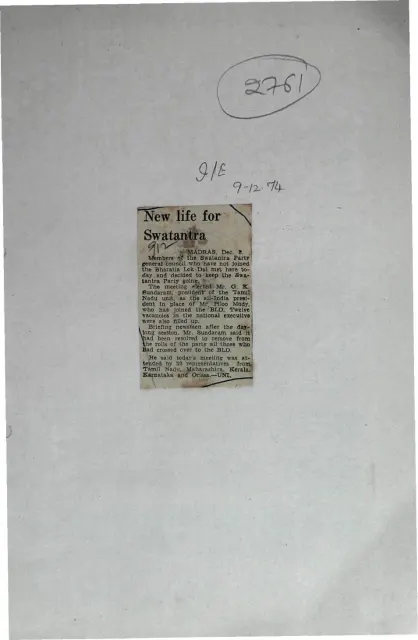
New life for Swatantra
Indian Express · Bombay · 1974
2 pages
Summary
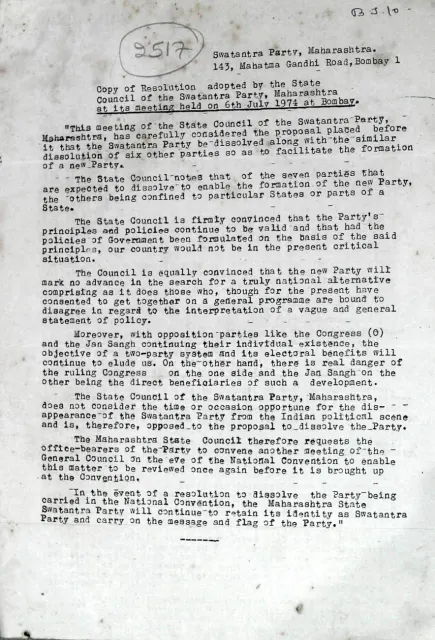
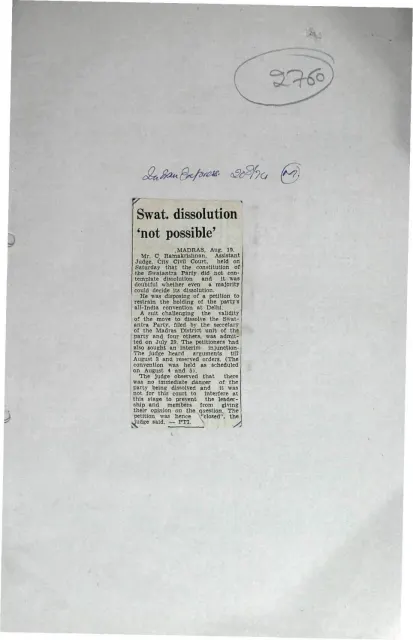
This two-page English archival item combines an Indian Express clipping dated 9 December 1974 with a copy of a resolution adopted by the Maharashtra State Council of the Swatantra Party at Bombay on 6 July 1974. The clipping reports that members who had not joined the Bharatiya Lok Dal decided to preserve the Swatantra Party organisation; G. K. Sundaram was elected president of the Tamil Nadu unit and was appointed all-India president in place of Piloo Mody. It also states that vacancies in the national executive were filled and that the meeting included representatives from Tamil Nadu, Maharashtra, Kerala, Karnataka, and Orissa.
The Maharashtra resolution rejects the proposal to dissolve the Swatantra Party alongside six other parties to facilitate the formation of a new party. It argues that Swatantra principles and policies remain valid, questions whether a new party based on a vague general programme can provide a genuine national alternative, and warns that the continued existence of Congress (O) and Jan Sangh frustrates the emergence of a two-party system. The State Council therefore requests another General Council meeting before the national convention and declares that, if dissolution is approved, the Maharashtra organisation will retain its identity and continue the party’s message and flag.
Key points
- The item records a 1974 effort by Swatantra Party members to preserve the party despite a proposed merger or dissolution.
- G. K. Sundaram was elected president of the Tamil Nadu unit and appointed all-India president in place of Piloo Mody.
- The Maharashtra State Council opposed dissolving Swatantra along with six other parties to form a new party.
- The resolution maintains that Swatantra’s principles and policies remain valid.
- It argues that a vague common programme would not necessarily produce a genuinely national political alternative.
- The resolution links the survival of Congress (O) and Jan Sangh to the failure to establish a two-party system.
- The Maharashtra Council sought renewed deliberation before the national convention and pledged to preserve the party’s identity if dissolution went ahead.
Metadata and summary are AI-extracted from the source PDF and reviewed for editorial accuracy. The original work is available via the Read PDF tab above (where present); paragraph-level citation inside the PDF is deferred to a future engagement.