essay
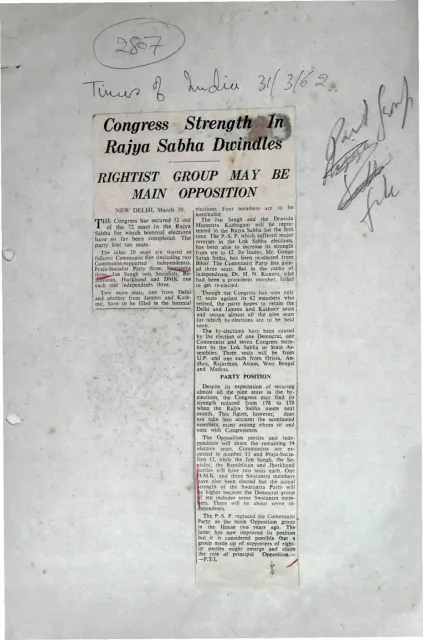
Congress Strength In Rajya Sabha Dwindles
RIGHTIST GROUP MAY BE MAIN OPPOSITION
Times of India · New Delhi · 1962
1 pages
Summary
This Times of India news report, dated March 30, 1962, examines the Congress party’s reduced strength in the Rajya Sabha after the completion of biennial elections. It reports that Congress secured 52 of the 72 seats contested, while the remaining seats went to a range of opposition and independent candidates, including members associated with the Communist, Praja-Socialist, Swatantra, Jan Sangh, Republican, DMK, and Dravidian movements.
The report argues that Congress may nevertheless retain practical control because it is expected to win most forthcoming by-elections, including seats from Delhi and Jammu and Kashmir. It identifies the political significance of the new composition: opposition parties and independents will share the remaining 54 elective seats, while the Praja-Socialist Party is described as having replaced the Communist Party as the principal opposition group. The article concludes that the rightist parties may combine to claim the role of principal opposition.
Key points
- Congress won 52 of the 72 Rajya Sabha seats for which biennial elections had been completed.
- The remaining 20 seats were distributed among Communist-supported independents, Praja-Socialists, Swatantra, Jan Sangh, Socialists, Republicans, Jharkhand representatives, DMK members, and other independents.
- Four additional members were to be nominated, and two seats from Delhi and Jammu and Kashmir were to be filled in biennial elections.
- The report states that the Praja-Socialist Party had increased its Rajya Sabha strength from 5 to 12 seats.
- Congress was expected to win most of the nine seats due to be filled in by-elections, including seats from Delhi and Jammu and Kashmir.
- Opposition parties and independents were expected to share the remaining 54 elective seats.
- The Praja-Socialist Party is presented as having replaced the Communist Party as the main opposition group.
- The article suggests that rightist parties might combine to claim the role of principal opposition.
Metadata and summary are AI-extracted from the source PDF and reviewed for editorial accuracy. The original work is available via the Read PDF tab above (where present); paragraph-level citation inside the PDF is deferred to a future engagement.