press note
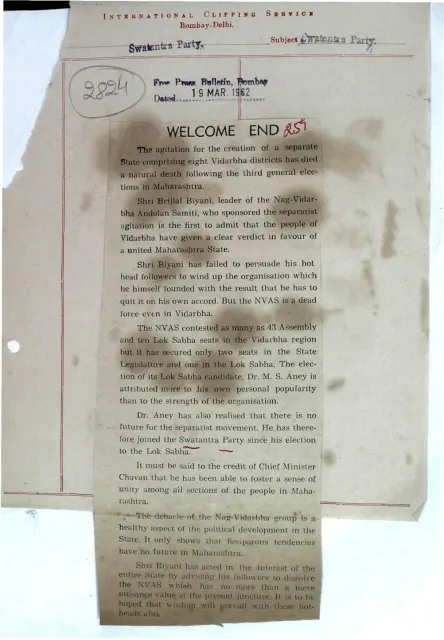
WELCOME END
Bombay · 1962
1 pages
Summary
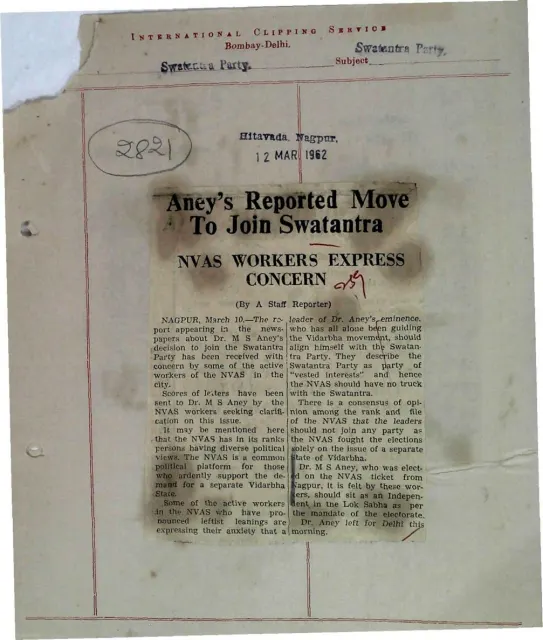
This one-page English press bulletin, dated 19 March 1962, declares that the movement for a separate Vidarbha state has effectively ended after Maharashtra’s third general election. It presents Brijlal Biyani, leader of the Nag-Vidarbha Andolan Samiti (NVAS), as acknowledging that Vidarbha’s voters have delivered a clear verdict in favour of a united Maharashtra, although he has been unable to persuade his followers to dissolve the organisation.
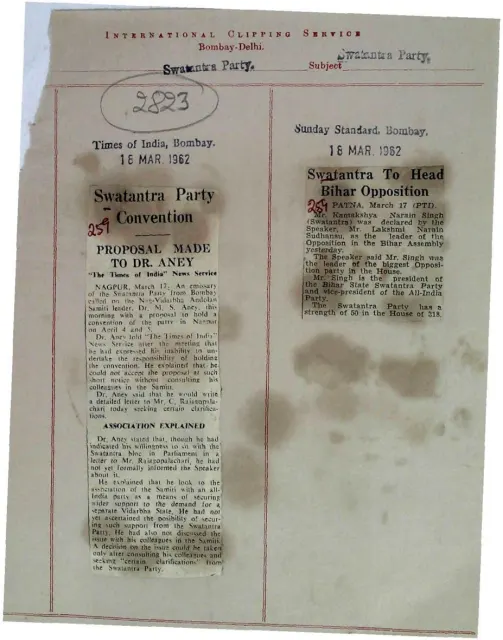
The bulletin supports this conclusion with NVAS’s poor electoral performance: it contested 43 Assembly seats and 10 Lok Sabha seats in Vidarbha but won only two state-legislature seats and one Lok Sabha seat. It attributes the Lok Sabha victory of Dr. M. S. Aney chiefly to his personal popularity, notes that Aney subsequently joined the Swatantra Party, and credits Chief Minister Chavan with fostering unity across Maharashtra. The text treats the collapse of the separatist organisation as evidence that fissiparous tendencies have no future in the state.
Key points
- The bulletin argues that the separate-Vidarbha movement has been defeated by the 1962 election results.
- Brijlal Biyani is described as recognising public support for a united Maharashtra.
- The Nag-Vidarbha Andolan Samiti contested 43 Assembly and 10 Lok Sabha seats but won only two state seats and one parliamentary seat.
- Dr. M. S. Aney’s Lok Sabha victory is attributed more to personal popularity than to NVAS organisational strength.
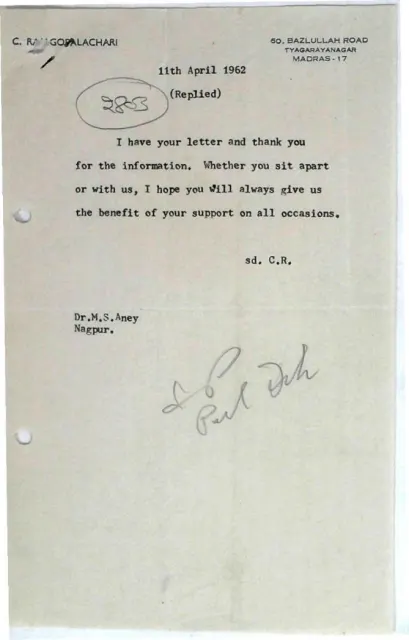
- Aney is said to have joined the Swatantra Party after his election.
- The bulletin credits Chief Minister Chavan with promoting unity among Maharashtra’s communities.
- The text concludes that separatist tendencies have no future in Maharashtra.
Metadata and summary are AI-extracted from the source PDF and reviewed for editorial accuracy. The original work is available via the Read PDF tab above (where present); paragraph-level citation inside the PDF is deferred to a future engagement.