letter
Letter to Mr Girish Munshi
1963
1 pages
Summary
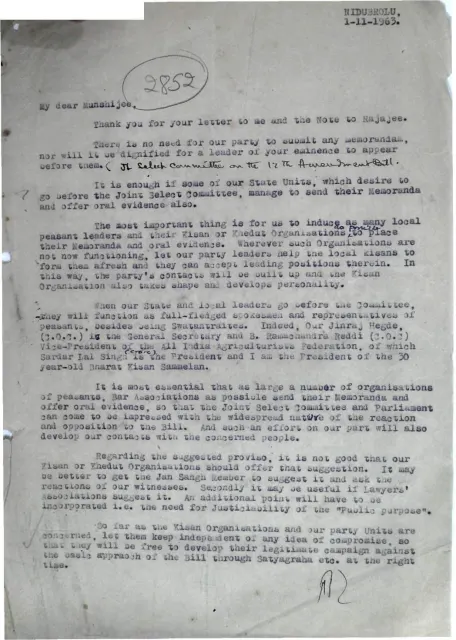
This undated-in-title letter, dated 1 November 1963 and addressed to “Munshijee,” sets out a strategy for the Swatantra Party’s engagement with the Joint Select Committee on the 17th Amendment Bill. The writer rejects the need for a formal party memorandum or for a senior leader to appear before the committee, arguing instead that state units should submit memoranda and oral evidence. The central recommendation is to mobilise local peasant leaders and existing kisan or agricultural organisations to present the breadth of rural reaction against the Bill.
The letter also proposes using the committee process to strengthen the party’s local organisation. Party leaders are encouraged to help kisans form or take over local organisations, while state and local leaders would appear as representatives of peasants as well as Swatantra members. The writer urges broad participation by peasant and bar associations, suggests that the Jan Sangh and lawyers’ associations be consulted on a proposed provision, and calls for the “justiciability of the public purpose” to be incorporated. Kisan organisations and party units are advised to remain independent of compromise so they can pursue a legitimate satyagraha campaign against the Bill. The author’s handwritten signature is not securely identifiable from the page.
Key points
- The writer opposes a formal Swatantra Party memorandum or senior-leader appearance before the Joint Select Committee on the 17th Amendment Bill.
- State units are encouraged to submit memoranda and provide oral evidence to the committee.
- Local peasant leaders and kisan or agricultural organisations should be mobilised to demonstrate rural reaction and opposition to the Bill.
- The committee process is presented as an opportunity to build Swatantra Party contacts with local kisans and develop durable kisan organisations.
- State and local leaders should appear as both representatives of peasants and members of the Swatantra Party.
- The writer recommends consultation with the Jan Sangh and lawyers’ associations regarding a proposed provision, including the justiciability of the public purpose.
- Kisan organisations and party units should remain independent of compromise and retain the option of a satyagraha campaign.
Metadata and summary are AI-extracted from the source PDF and reviewed for editorial accuracy. The original work is available via the Read PDF tab above (where present); paragraph-level citation inside the PDF is deferred to a future engagement.