
essay
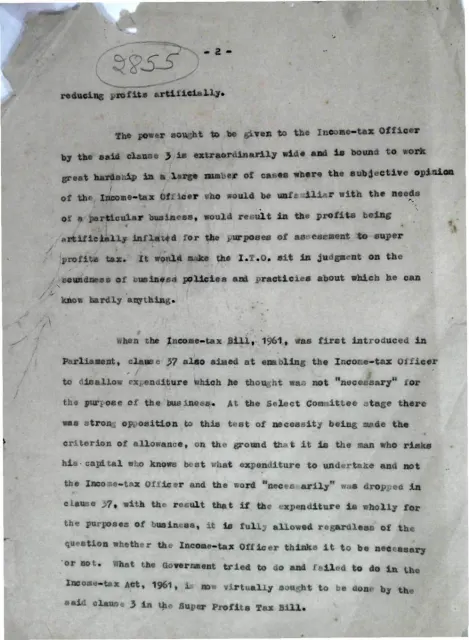
Reducing Profits Artificially
1 pages
Summary
On the visible continuation page, the essay argues that clause 3 of the Super Profits Tax Bill gives the Income-tax Officer excessively broad discretion to determine whether business profits have been reduced artificially. It warns that an officer unfamiliar with the needs of a particular business could impose a subjective assessment, artificially inflate reported profits, and expose them to super profits tax. The text also objects to placing the tax official in judgment over the soundness of business policies and practices about which he may know very little.
The page compares this proposal with clause 37 of the Income-tax Bill, 1961. That clause initially allowed an officer to disallow expenditure he considered not “necessary” for the purposes of a business. After strong opposition at the Select Committee stage, the word “necessarily” was removed, leaving expenditure wholly incurred for business purposes fully allowable regardless of the officer’s view of its necessity. The author presents clause 3 of the Super Profits Tax Bill as seeking to reintroduce, in substance, the same kind of official judgment that the earlier legislative revision rejected.
Key points
- Clause 3 of the Super Profits Tax Bill is described as granting the Income-tax Officer extraordinarily wide powers.
- The page warns that subjective official judgments could artificially inflate business profits for super profits tax assessment.
- It argues that tax officials may lack sufficient knowledge of the business policies and practices they would be judging.
- The Income-tax Bill, 1961 initially used a necessity test to permit disallowance of business expenditure.
- Opposition at the Select Committee stage led to removal of the word “necessarily” from clause 37.
- Business expenditure wholly incurred for business purposes was consequently to be allowed regardless of the officer’s opinion about its necessity.
- The page argues that clause 3 of the Super Profits Tax Bill effectively sought to restore the rejected approach.
Metadata and summary are AI-extracted from the source PDF and reviewed for editorial accuracy. The original work is available via the Read PDF tab above (where present); paragraph-level citation inside the PDF is deferred to a future engagement.
Related across the archive
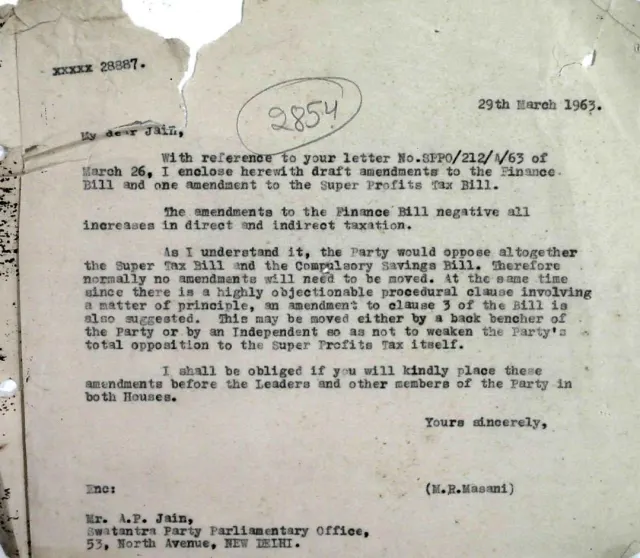 Primary workLetter to A P Jain
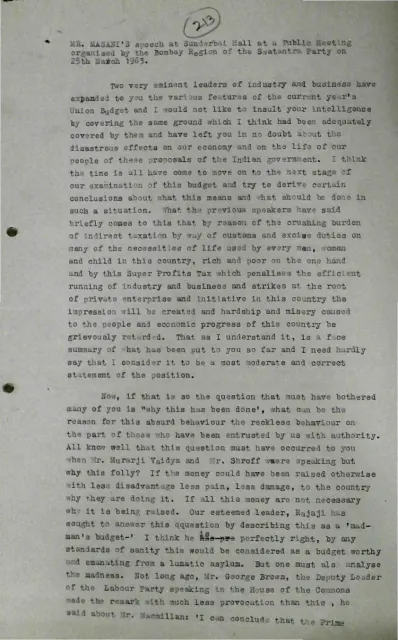 Primary workMR. MASANI'S speech at Sunderbai Hall at a Public Meeting organised by the Bombay Region of the Swatantra Party on 25th March 1963.
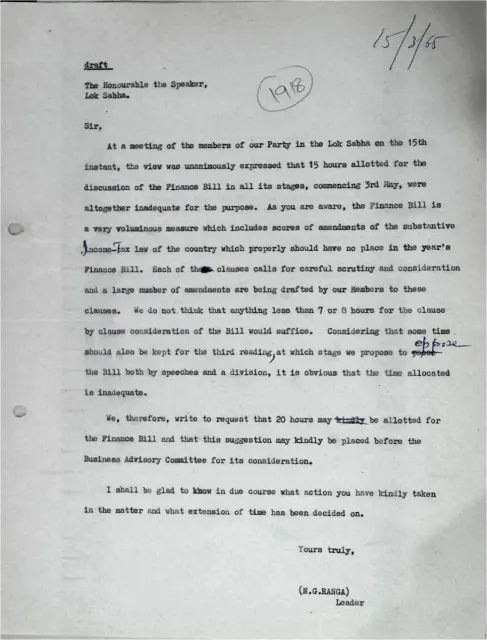 Primary workLetter from NG Ranga
 ExcerptCrushing Burden of Taxation - Nani Palkhivala
 ExcerptSTATE MONOPOLIES AND THE CITIZEN IN A DEMOCRACY