essay
The Wisest Man in India: Aspects of C. Rajagopalachari
20 pages
Summary
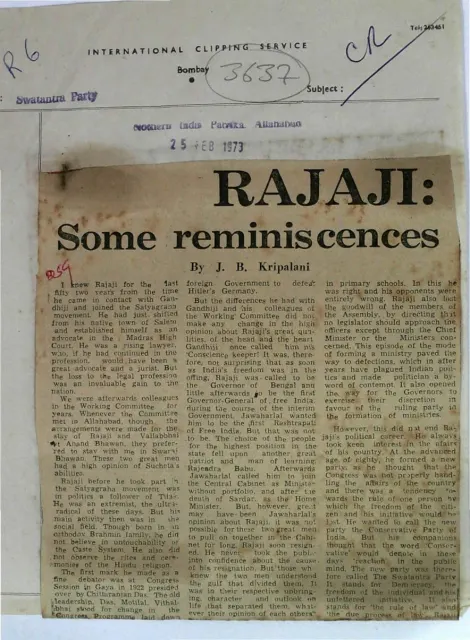
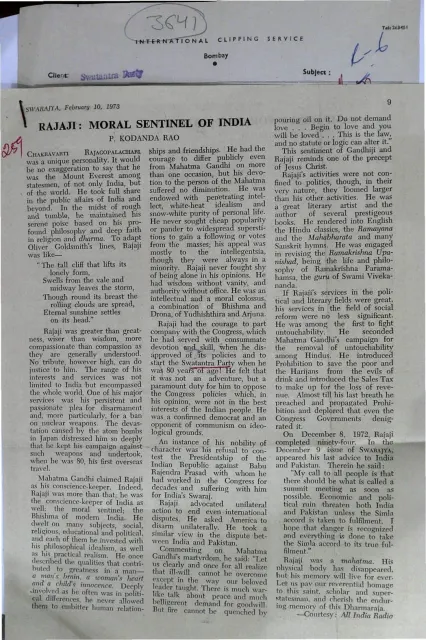
This essay presents C. Rajagopalachari (Rajaji) as a politician of unusual range, conviction, and intellectual independence. It recalls his career as lawyer, administrator, governor-general, chief minister, writer, and popular interpreter of the Ramayana and Mahabharata, while emphasizing his Hindu faith, affection for Christian values, advocacy of Hindu-Muslim reconciliation, support for better relations with Pakistan, and criticism of India’s licence-permit-quota system. The author characterizes Rajaji’s political life chiefly as a search for reconciliation across religious, regional, caste, and national divisions, but also acknowledges his conservative views on women and his limitations.
Key points
- Rajaji is portrayed as a politically exceptional figure whose career combined public office, law, literature, administration, and religious thought.
- His politics are presented as consistently oriented toward reconciliation between Hindu and Muslim, India and Pakistan, India and England, and North and South India.
- The essay describes Rajaji’s close but non-subservient discipleship to Mahatma Gandhi, including disagreements over Quit India, Congress strategy, untouchability, Hindu-Muslim harmony, and the dignity of labour.
- Rajaji’s relationship with Jawaharlal Nehru is examined as both cooperative and adversarial, especially over socialism, state planning, private enterprise, and the proper role of political opposition.
- The author emphasizes Rajaji’s commitment to independent thinking and his belief that a democracy requires an effective opposition capable of criticizing and humanizing the ruling party.
- Rajaji’s opposition to nuclear weapons and nuclear power is presented as an extension of his Gandhian ethics and concern for future generations.
- The essay closes its visible discussion by stressing Rajaji’s advocacy of small, useful projects and individual initiative over grandiose development schemes.
Metadata and summary are AI-extracted from the source PDF and reviewed for editorial accuracy. The original work is available via the Read PDF tab above (where present); paragraph-level citation inside the PDF is deferred to a future engagement.