report · report
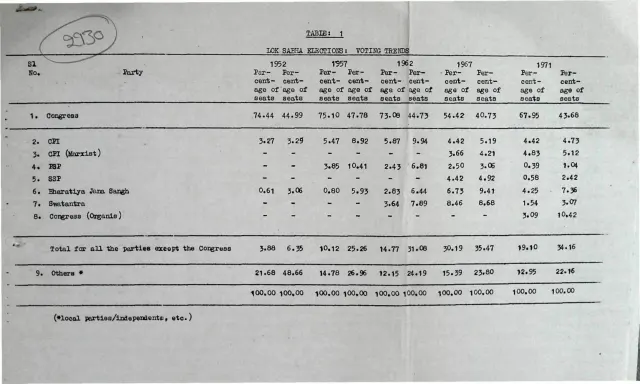
LOK SABHA ELECTIONS: VOTING TRENDS
10 pages
Summary
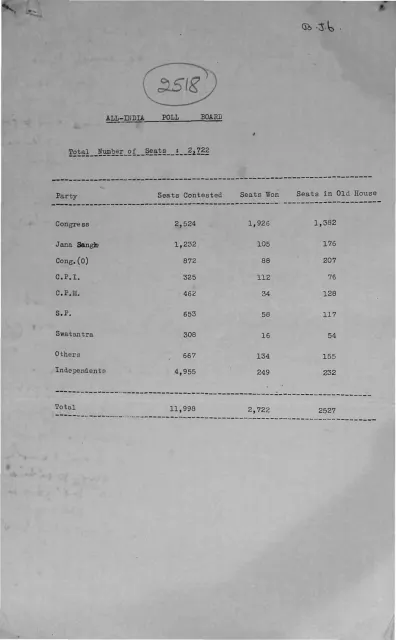
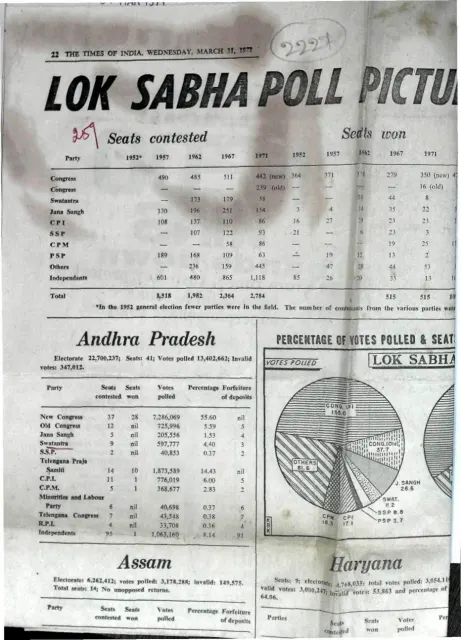
This statistical report compiles voting and seat trends in Indian elections from 1952 through 1974. Its opening tables compare the Congress and other major parties in Lok Sabha elections, showing the Congress’s continuing dominance alongside the gradual growth of non-Congress parties, including the CPI, CPI (Marxist), Bharatiya Jana Sangh, Swatantra, and Congress (Organisation). The tables distinguish vote share from seat share, making visible the conversion of pluralities into disproportionately large legislative majorities.
The later tables turn to state assembly results, especially the effects of opposition alliances in Gujarat and Uttar Pradesh. They compare party performance across states and constituencies, including vote swings in alliance and non-alliance contests. Additional tables examine assembly outcomes in Orissa, Pondicherry, Manipur, and Nagaland, and calculate the Congress’s vote-seat multiplier. The compilation is primarily descriptive: it provides comparative electoral evidence on party competition, alliances, regional variation, and the relationship between votes and representation. One table is identified as being drawn from an article by Stanley Heginbotham in Asian Survey; the document’s own compiler and institutional provenance are not stated.
Key points
- The report compares Lok Sabha voting and seat trends from 1952 to 1971.
- Congress retains a commanding share of seats while its vote share fluctuates across elections.
- Non-Congress parties collectively increase their share of votes and seats over the period shown.
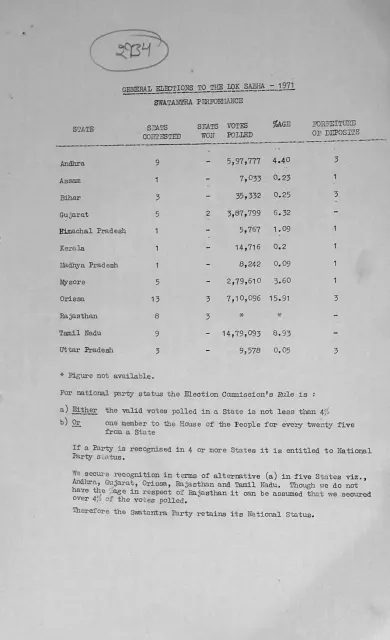
- State-wise tables document substantial regional variation in party competition during the 1971 and 1972 assembly elections.
- The Gujarat table compares undivided-Congress results in 1967 with alliance results in 1971 and separate opposition contests in 1972.
- The Uttar Pradesh table compares Jan Sangh, SSP, and Congress (O) performance in alliance and open-contest constituencies.
- The vote-seat multiplier tables show that Congress converted its vote share into a larger percentage of seats, particularly in 1971 and 1972.
Metadata and summary are AI-extracted from the source PDF and reviewed for editorial accuracy. The original work is available via the Read PDF tab above (where present); paragraph-level citation inside the PDF is deferred to a future engagement.