Summary
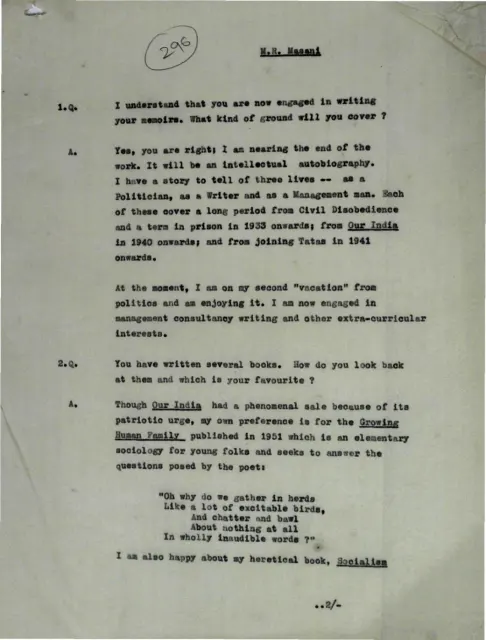
In this four-page question-and-answer interview, M. R. Masani describes a planned “intellectual autobiography” organized around three phases of his life: politician, writer, and management professional. He traces the political period from Civil Disobedience and imprisonment in 1933 onward, the writing period from Our India in 1940 onward, and his corporate career from joining Tata in 1941. He says that, at the time of the interview, he is on a second “vacation” from politics and working in management consultancy and writing.
Masani identifies The Growing Human Family, published in 1951, as his favourite book, describing it as an elementary sociology for young people. He also discusses Reconsidered, in which he says he renounced Marxism and turned toward Gandhiji’s socio-economic thought, and his History of the Communist Party of India, written as a research project for the Institute of Pacific Relations. The interview then turns to his seventeen years at Bombay House, his work with Tata companies and J. R. D. Tata, his support for labour and the right to strike, and the origins of his consultancy firm. He presents management consultancy as a field that grew from infancy into what he calls a “managerial Revolution” in India.
Transcript
Summary
In this four-page question-and-answer interview, M. R. Masani describes a planned “intellectual autobiography” organized around three phases of his life: politician, writer, and management professional. He traces the political period from Civil Disobedience and imprisonment in 1933 onward, the writing period from Our India in 1940 onward, and his corporate career from joining Tata in 1941. He says that, at the time of the interview, he is on a second “vacation” from politics and working in management consultancy and writing.
Masani identifies The Growing Human Family, published in 1951, as his favourite book, describing it as an elementary sociology for young people. He also discusses Reconsidered, in which he says he renounced Marxism and turned toward Gandhiji’s socio-economic thought, and his History of the Communist Party of India, written as a research project for the Institute of Pacific Relations. The interview then turns to his seventeen years at Bombay House, his work with Tata companies and J. R. D. Tata, his support for labour and the right to strike, and the origins of his consultancy firm. He presents management consultancy as a field that grew from infancy into what he calls a “managerial Revolution” in India.
Key points
- Masani frames his projected autobiography around his lives as politician, writer, and management professional.
- He dates his political experience from Civil Disobedience and imprisonment in 1933 onward.
- He prefers The Growing Human Family to Our India and characterizes it as an elementary sociology for young readers.
- He says Reconsidered marked his renunciation of Marxism and turn toward Gandhian socio-economic thought.
- He discusses his History of the Communist Party of India as a deliberately objective research work.
- He recalls his varied responsibilities at Bombay House, ending as executive head of J. R. D. Tata’s office.
- He defends labour’s right to strike while describing his consultancy role as neutral and conciliatory.
- He attributes the founding of his consultancy to his 1957 election to Parliament and notes the subsequent growth of management consultancy in India.
Metadata and summary are AI-extracted from the source PDF and reviewed for editorial accuracy. The original work is available via the Read PDF tab above (where present); paragraph-level citation inside the PDF is deferred to a future engagement.