letter
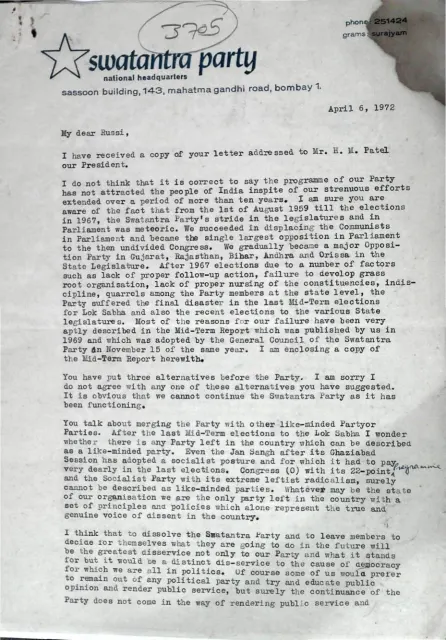
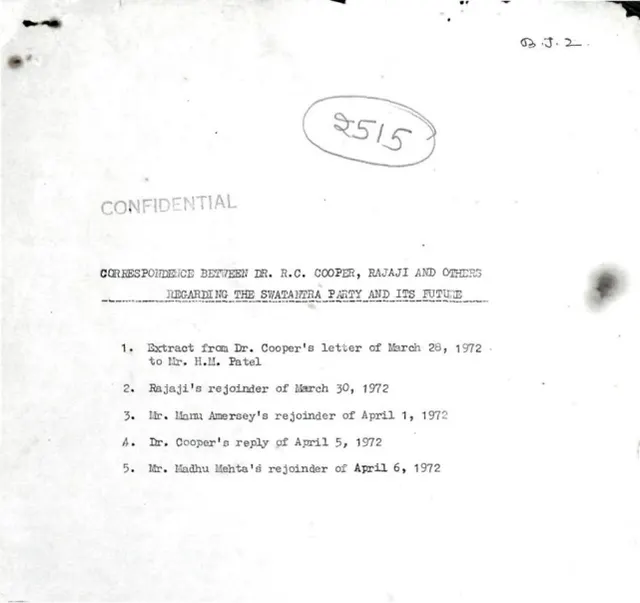
Letter to R C Cooper
1972
4 pages
Summary
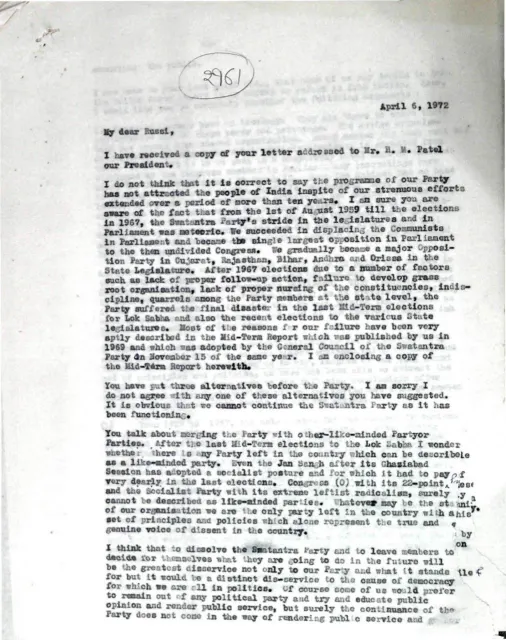
In this letter dated April 6, 1972, Madhu Mehta responds to R. C. Cooper’s proposal concerning the future of the Swatantra Party. Mehta rejects the claim that the party’s programme failed to attract Indians, recalling its rapid electoral growth between 1959 and 1967, its displacement of the Communists in Parliament, and its emergence as a major opposition force in several states. He attributes the party’s subsequent decline to weak organisation, inadequate constituency work, factionalism, poor financial arrangements, and the absence of sustained political follow-up after elections.
Mehta rejects dissolution of the Swatantra Party or a merger with other parties, arguing that it remains the country’s only significant voice for individual freedom and dissent. He is also sceptical that joining the Congress could reform it from within, describing Congress members as lacking ideology and serving personal interests, power, and patronage. The letter concludes with a call to rebuild the party from scratch through political education, regular contact with members and the public, clearer communication of Swatantra principles, and resistance to what Mehta portrays as Indira Gandhi’s authoritarian and socialist politics.
Key points
- Mehta disputes the claim that the Swatantra Party’s programme failed to attract public support.
- The party’s electoral success from 1959 to 1967 is attributed to credible leadership and a respected alternative programme.
- Organisational decay followed the 1967 elections because of weak grassroots work, poor constituency contact, inadequate training, and internal quarrels.
- Mehta rejects dissolving the Swatantra Party or merging it with other parties.
- The Congress is depicted as an organisation driven by power, patronage, personal interest, and obedience to its leadership.
- The letter argues that joining Congress would not transform its underlying political character.
- Rebuilding requires sustained public education, ideological training, personal contact, and active work beyond election periods.
Metadata and summary are AI-extracted from the source PDF and reviewed for editorial accuracy. The original work is available via the Read PDF tab above (where present); paragraph-level citation inside the PDF is deferred to a future engagement.