letter
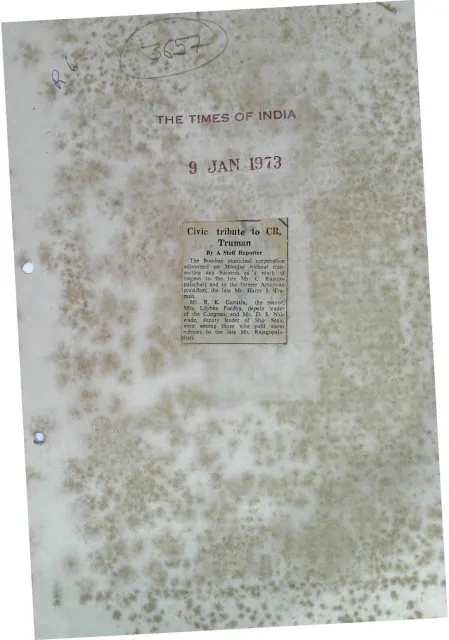
Best Complments of Dahyabhai V Patel
New Delhi · 1969
2 pages

Summary
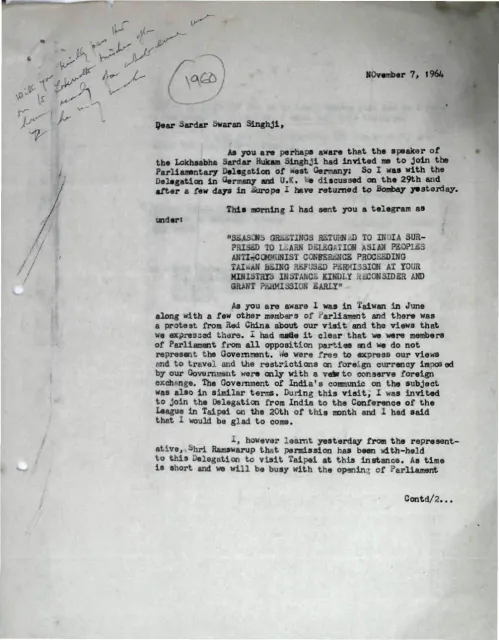
This two-page archival item comprises a complimentary card from Dahyabhai V. Patel and a typed letter dated October 16, 1969, addressed to G. S. Dhillon, Speaker of the Lok Sabha. Patel objects to the proposed composition of India’s delegation to an Inter-Parliamentary Conference in New Delhi, arguing that the principal opposition party has been excluded while nominated and allegedly non-party figures have been included. He asks the Speaker to revise the list and questions the democratic basis for representing the people through unelected nominees. In the letter’s second half, Patel broadens his criticism to India’s foreign-policy and parliamentary conduct. He recalls his participation in earlier Asian parliamentary meetings, complains that the External Affairs Ministry is obstructing closer ties with Asian countries, and condemns what he calls political “untouchability” toward Taiwan. He also invokes India’s historical relationship with Chiang Kai-shek and criticizes officials whom he suspects of serving Soviet rather than Indian interests. The item offers a sharply partisan intervention linking parliamentary representation, opposition rights, and Asian diplomacy.
Key points
- The item includes a complimentary card and a typed letter dated October 16, 1969. Dahyabhai V. Patel protests the exclusion of his party from an Inter-Parliamentary Conference delegation. He questions the democratic legitimacy of nominated representatives and asks whom they represent. He criticizes the inclusion of Joachim Alva and A. D. Mani in the proposed delegation. He describes India’s foreign-policy establishment as obstructing closer relations with Asian countries. He criticizes India’s refusal to engage with Taiwan and recalls Chiang Kai-shek’s support for Indian independence.
- He ends by questioning whether some External Affairs Ministry officials serve India or the Soviet Union.
Metadata and summary are AI-extracted from the source PDF and reviewed for editorial accuracy. The original work is available via the Read PDF tab above (where present); paragraph-level citation inside the PDF is deferred to a future engagement.