letter
Letter to N G Ranga
Swatantra Party · Bombay · 1969
3 pages
Summary
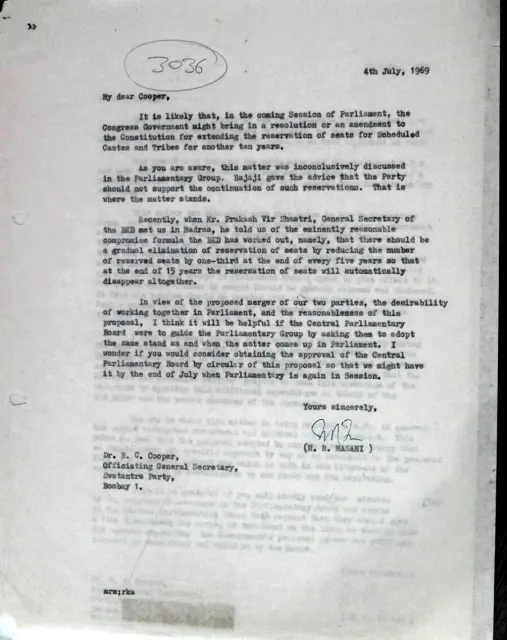
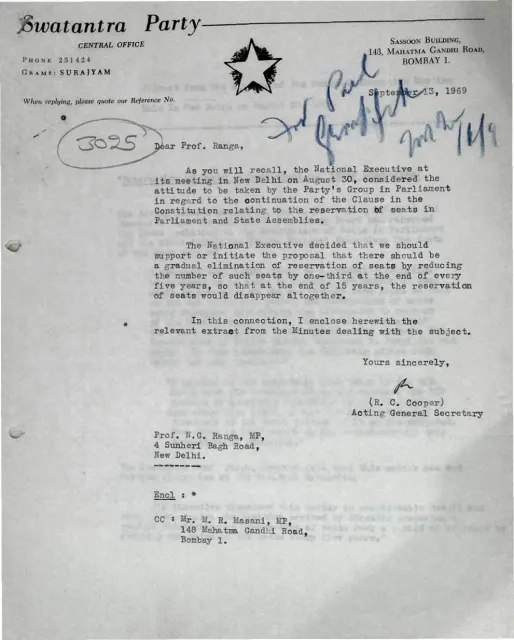
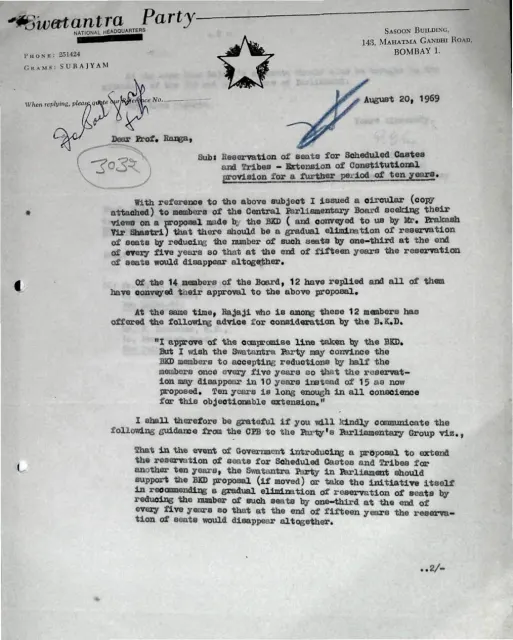
This three-page Swatantra Party document consists of a letter dated August 20, 1969, from R. C. Cooper, Acting for the General Secretary, to Prof. N. G. Ranga. It asks Ranga to guide the party’s Parliamentary Group on a proposal to extend reservations of seats for Scheduled Castes and Tribes. The enclosed Central Parliamentary Board Circular No. 46, dated July 10, 1969, records that C. Rajagopalachari had earlier opposed continuation of the reservations, while the B.K.D. proposed a gradual phase-out: reducing reserved seats by one-third every five years so that they would disappear after fifteen years.
Cooper reports that twelve of fourteen Board members had approved this compromise and asks Ranga to advise whether the Swatantra Party should support the B.K.D. proposal or independently recommend the same formula. The letter also relays Rajaji’s alternative suggestion that the reduction occur by half every five years, allowing the reservations to disappear after ten years. The document therefore captures an intra-party effort to formulate a parliamentary position on the constitutional extension of political reservations, while emphasizing cooperation with the B.K.D. during merger discussions.
Key points
- R. C. Cooper wrote to Prof. N. G. Ranga on August 20, 1969, seeking guidance on Scheduled Caste and Tribe seat reservations.
- The enclosed July 10 circular says the government might propose extending the reservations for another ten years.
- The B.K.D. proposed reducing reserved seats by one-third every five years, ending the system after fifteen years.
- Twelve of fourteen Central Parliamentary Board members had approved the B.K.D. formula.
- Rajaji supported the compromise but proposed a faster phase-out over ten years.
- The Swatantra Party was asked either to support the B.K.D. proposal in Parliament or introduce the same recommendation itself.
- The correspondence links the reservation question to ongoing merger discussions and coordination between the two parties.
Metadata and summary are AI-extracted from the source PDF and reviewed for editorial accuracy. The original work is available via the Read PDF tab above (where present); paragraph-level citation inside the PDF is deferred to a future engagement.