essay
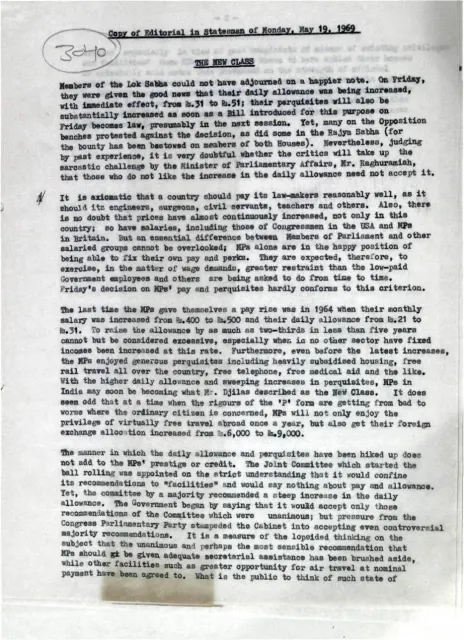
THE NEW CLASS
1969
2 pages
Summary
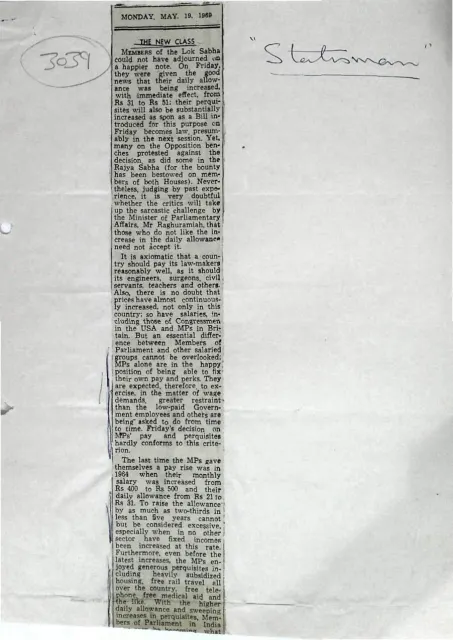
“The New Class,” published on 19 May 1969, criticises the Lok Sabha’s decision to increase MPs’ daily allowance from Rs 31 to Rs 51 and to raise their other allowances and privileges. The editorial notes that the measure faced opposition from some MPs and members of the Rajya Sabha, while Parliamentary Affairs Minister Mr Raghuramaiah reportedly challenged critics to decline the increase if they disliked it. It accepts that lawmakers should be paid adequately, but argues that MPs’ special position and ability to determine their own remuneration require restraint and public accountability.
The article contrasts MPs’ rising benefits—including subsidised housing, free rail travel, telephone and medical facilities, and increased foreign-exchange allocations—with the worsening position of ordinary citizens and low-paid government employees. It questions the procedure by which a Joint Committee’s recommendations were expanded: although the committee was expected to address facilities rather than pay, the Government accepted a controversial majority recommendation for a substantial allowance increase. The editorial concludes that MPs must ask whether their enhanced emoluments and facilities are defensible in relation to the citizens they represent and claim to serve.
Key points
- The editorial challenges the 1969 increase in MPs’ daily allowance from Rs 31 to Rs 51.
- It distinguishes between reasonable remuneration for lawmakers and unjustified expansion of MPs’ privileges.
- It highlights MPs’ subsidised housing, free travel, medical facilities, telephones, and foreign-exchange allocations.
- It argues that MPs should exercise greater restraint than low-paid government employees because they can fix their own pay.
- It criticises the Government’s acceptance of a controversial majority recommendation from the Joint Committee.
- It frames MPs’ remuneration as a question of public trust and representation.
Metadata and summary are AI-extracted from the source PDF and reviewed for editorial accuracy. The original work is available via the Read PDF tab above (where present); paragraph-level citation inside the PDF is deferred to a future engagement.