Summary
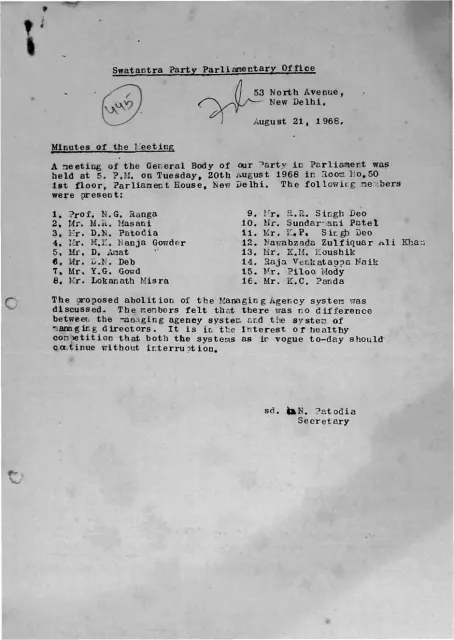
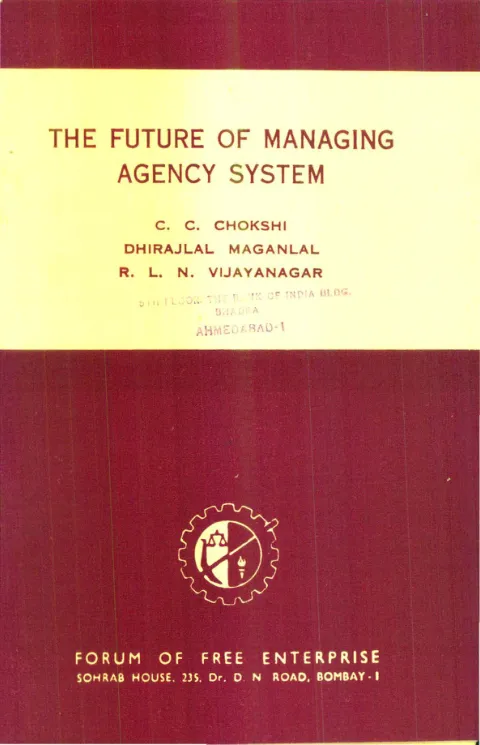
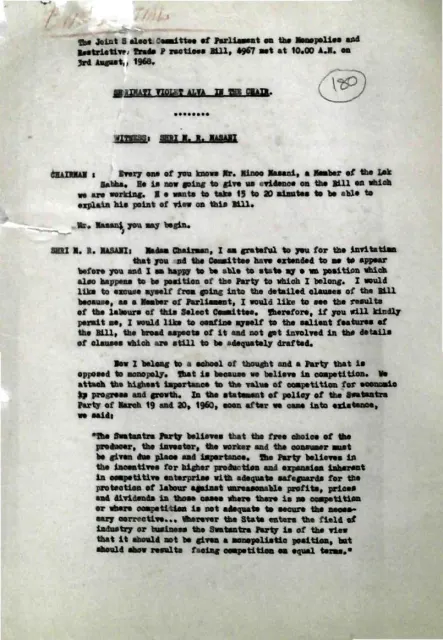
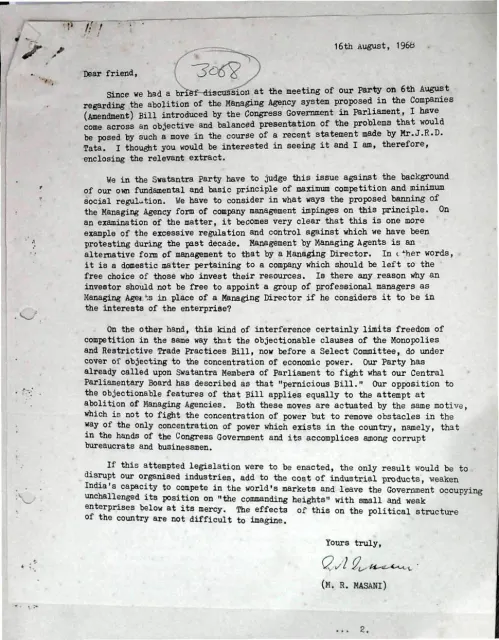
In this letter dated 16 August 1968, M. R. Masani explains the Swatantra Party’s opposition to the proposed abolition of the Managing Agency system. He argues that the system is an alternative form of company management that should be left to investors and enterprises to choose, and presents the proposed ban as another instance of excessive state regulation. He links this issue to the party’s broader commitment to maximum competition and minimum social regulation, while also opposing what he describes as the concentration of economic power in the hands of the Congress government and its allied bureaucrats and businessmen.
Masani encloses an extract from J. R. D. Tata’s 15 July 1968 statement to Tata Iron & Steel Company Limited. Tata argues that Managing Agencies can provide professional, experienced management suited to India’s need for rapid industrial expansion, while acknowledging that—as with any human institution—the system can be abused. The extract disputes the claim that Managing Agencies have uniquely caused the concentration of wealth or economic power, asserting instead that India’s licensing and control regime has transferred such power to government officials and ministers. It concludes that large firms may be necessary for efficiency, technological progress, lower costs, and international competitiveness, especially when smaller Indian enterprises lack comparable resources.
Key points
- Masani frames the Managing Agency debate as a question of economic liberty, competition, and the proper limits of state regulation.
- He argues that choosing between Managing Agents and Managing Directors is a private business decision that should remain with investors.
- He connects opposition to abolition with opposition to objectionable provisions of the Monopolies and Restrictive Trade Practices Bill.
- Masani warns that abolition could disrupt organised industries, raise industrial costs, weaken India’s international competitiveness, and strengthen the government’s dominance of the economy.
- The enclosed J. R. D. Tata extract defends the Managing Agency system as an efficient and professionally adaptable form of management for India.
- Tata distinguishes abuses of the system from the system itself, arguing that dishonesty and nepotism are not exclusive to Managing Agencies.
- Tata contends that economic power has been concentrated primarily through post-Independence government controls, licensing, and regulation rather than through the Managing Agency system.
- The extract stresses the importance of large-scale management, specialised expertise, research, and modern technology for industrial efficiency and competitiveness.
Metadata and summary are AI-extracted from the source PDF and reviewed for editorial accuracy. The original work is available via the Read PDF tab above (where present); paragraph-level citation inside the PDF is deferred to a future engagement.