essay · statement of principles
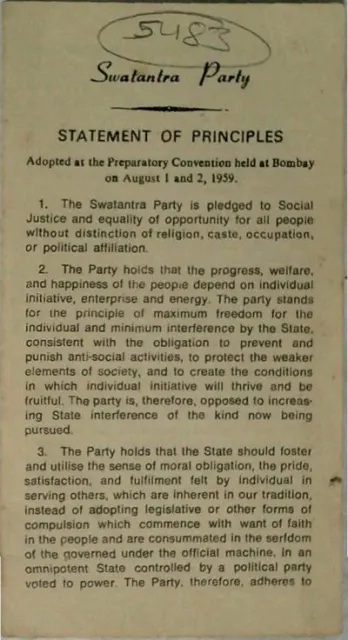
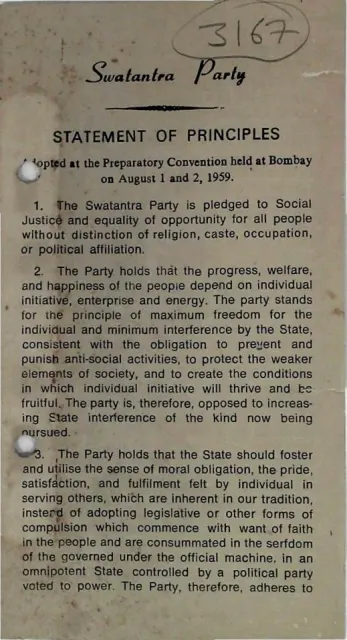
STATEMENT OF PRINCIPLES
Printed by : JAYANT ART PRINTERY PVT. LTD., TARDEO, BOMBAY-34. · Bombay · 1959
6 pages
Summary
The Swatantra Party’s Statement of Principles, adopted at its Preparatory Convention in Bombay on August 1–2, 1959, presents 21 commitments organized around social justice, equality of opportunity, individual initiative, and limited government. It argues that the State should prevent anti-social conduct and protect vulnerable people while otherwise minimizing interference, preserving property, occupation, trade, and educational choice. The statement also invokes moral obligation, spiritual and cultural values, and Gandhi’s principle of Trusteeship as alternatives to compulsory state-directed collectivism.
The economic program opposes expanding state control, collectivisation, bureaucratic management, excessive taxation, deficit financing, inflation, and indiscriminate nationalisation. It favours self-employed peasant proprietors, competitive enterprise, free distribution, decentralised industry, small artisans and traders, and safeguards for labour. The final principles call for reduced public administration, employment-generating industrialisation, fair collective bargaining, an independent judiciary, judicial review, adherence to truth and non-violence, and internal freedom of opinion for party members outside the Statement’s fundamental principles.
Key points
- The party links social justice and equality of opportunity with maximum individual freedom and minimum state interference.
- The State is assigned a limited protective and regulatory role: preventing anti-social activity and safeguarding weaker sections.
- The statement defends property rights, occupational freedom, parental choice in education, and protection against uncompensated compulsory acquisition.
- Agricultural policy centres on the self-employed peasant proprietor, improved irrigation, credit, inputs, marketing, and stable agricultural prices.
- The party rejects collectivisation, bureaucratic rural management, extensive state trading, and state enterprise beyond necessary heavy industries and national services.
- Fiscal and monetary principles oppose crippling taxation, excessive public expenditure, deficit financing, inflation, and unsustainable foreign borrowing.
- The programme supports decentralised industrialisation, small-scale and rural industries, full employment, labour organisation, and a fair balance between capital and labour.
- The statement affirms the rule of law, judicial independence, judicial review, non-violence, and freedom of opinion within the party.
Metadata and summary are AI-extracted from the source PDF and reviewed for editorial accuracy. The original work is available via the Read PDF tab above (where present); paragraph-level citation inside the PDF is deferred to a future engagement.