Summary
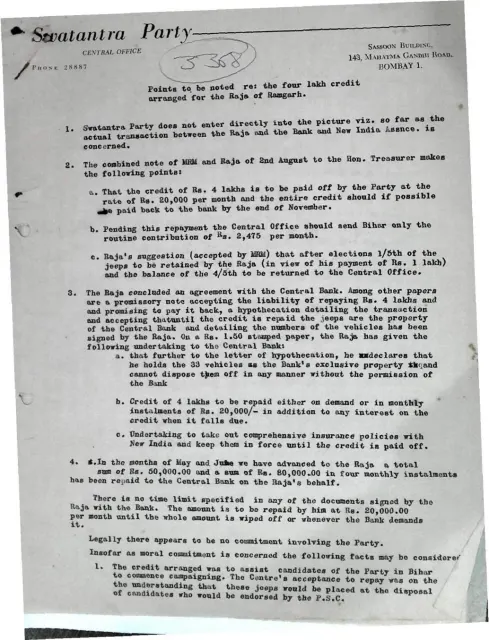
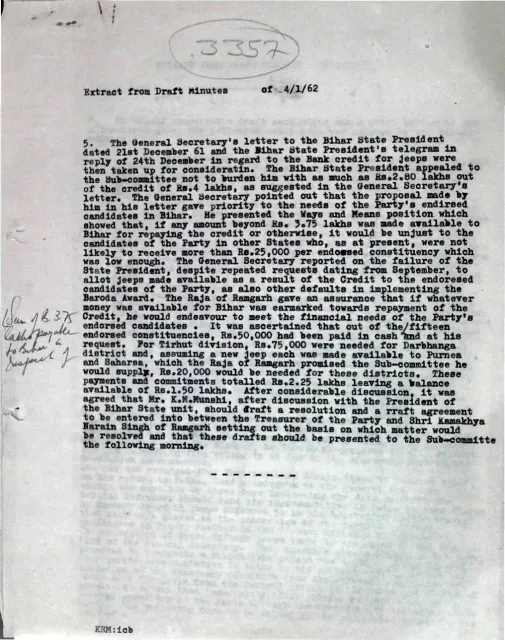
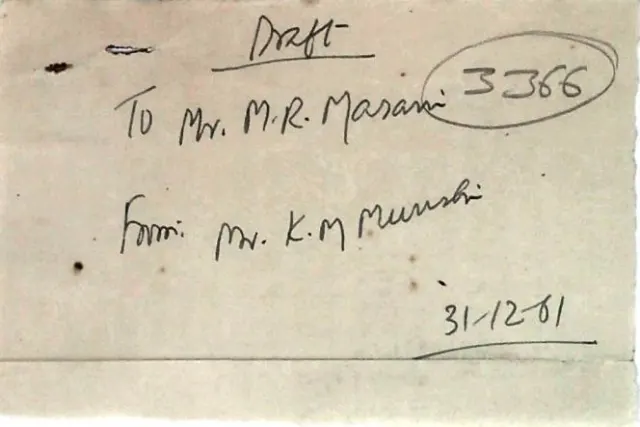
This draft memorandum from K. M. Munshi to M. R. Masani, dated 31 December 1961, sets out the Swatantra Party’s position regarding a financing arrangement involving Raja, the Central Bank of India, and the Bihar Party. It argues that the Party had no direct contractual relationship with the Bank: the property in 33 jeeps was vested in the Bank, with Raja acting only as trustee. At the same time, the Party had authorised the Bihar Party to raise up to Rs. 5.5 lakhs for jeeps and election-related worker maintenance, on the understanding that funds would support Centre-endorsed parliamentary candidates.
The memorandum describes an August 1961 arrangement under which the Treasurer would repay Raja’s Central Bank credit in monthly instalments of Rs. 20,000, with those payments set off against amounts due to the Bihar Party, and Raja would eventually transfer 26 of the 33 jeeps to the Swatantra Party at the Centre. Munshi records that Rs. 130,000 had already been advanced or repaid, but alleges that Raja failed to earmark or deliver the promised jeeps to endorsed candidates. Because candidates in Darbhanga, Purnea, and Saharsa lacked vehicles, the Party had to finance the purchase of second-hand jeeps. The memorandum concludes that Raja’s failure to fulfil the arrangement justified withholding the Party’s monthly instalment payments to the Bank.
Key points
- The memorandum distinguishes the Party’s political understanding with Raja from Raja’s direct contractual relationship with the Central Bank of India.
- The Bihar Party was authorised to raise up to Rs. 5.5 lakhs for jeeps and election-worker maintenance in the 1961 Swatantra Party campaign.
- An August 2, 1961 arrangement required monthly Bank repayments of Rs. 20,000 and the eventual transfer of 26 jeeps to the Swatantra Party.
- The document records Rs. 50,000 advanced to Raja and Rs. 80,000 repaid to the Central Bank, totalling Rs. 130,000.
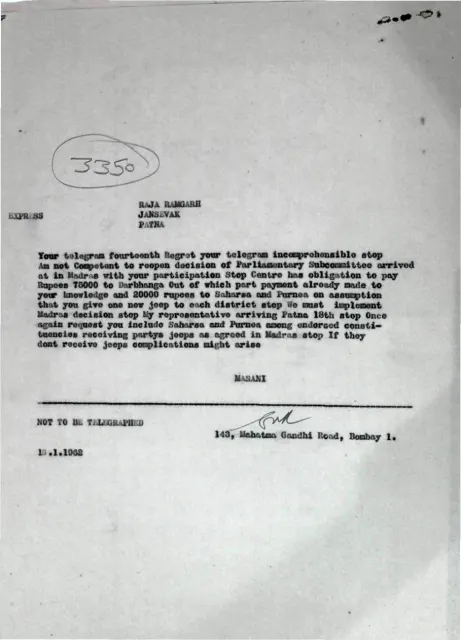
- Munshi alleges that Raja did not earmark or distribute the 26 jeeps to Centre-endorsed parliamentary candidates.
- The shortage of vehicles forced the Party to pay for second-hand jeeps for candidates in Darbhanga, Purnea, and Saharsa.
- The memorandum argues that Raja’s non-performance released the Party from its obligation to continue paying the Bank’s monthly instalments.
Metadata and summary are AI-extracted from the source PDF and reviewed for editorial accuracy. The original work is available via the Read PDF tab above (where present); paragraph-level citation inside the PDF is deferred to a future engagement.