constitution
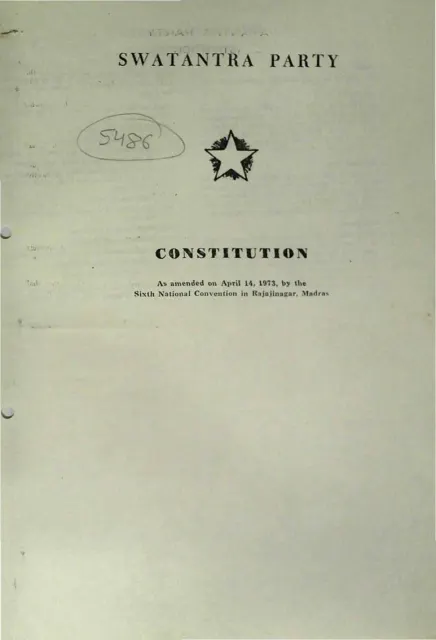
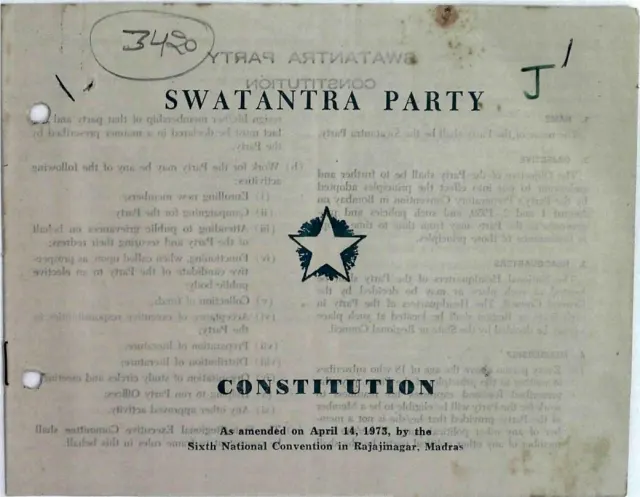
CONSTITUTION
published by S. V. Raju, Executive Secretary, Swatantra Party, National Headquarters, 143 M. G. Road, Bombay 400 001. · Bombay · 1973
12 pages
Summary
This 1973 Swatantra Party Constitution, amended on April 14, 1973, by the Party’s Sixth National Convention in Rajajinagar, Madras, defines the Party’s name, objectives, membership rules, organisational hierarchy, electoral procedures, and amendment process. It establishes a structure running from Primary and District Units through State or Regional Councils to a General Council and National Executive.
The document sets out membership subscriptions, disciplinary powers and appeal rights, proportional representation for internal councils, and procedures for electing office-bearers. It also creates State and National Election Tribunals, specifies voting and scrutiny rules, permits limited co-option, and reserves constitutional amendment to the National Convention through specified majority thresholds. The final page includes an appendix governing voting procedures for Party elections.
Key points
- The document identifies the organisation as the Swatantra Party and states its objectives, including political activity, public education, elections, and the promotion of Party principles.
- Membership requires an annual subscription of Re. 1; members who pay subscriptions for twenty years or more are deemed members for life.
- The Constitution establishes Primary Units, District Committees, State or Regional Councils, a General Council, and a National Executive.
- It provides disciplinary procedures involving suspension or expulsion, with sequential rights of appeal from District to State or Regional and National bodies.
- Internal representation is organised through proportional representation, while State and Regional Councils elect executive committees.
- State and National Election Tribunals are created to resolve disputes over Party elections, with appeals and final decision-making assigned to specified Party bodies.
- Amendments may be proposed at a National Convention by the General Council or by 200 Party members and require the prescribed majority of delegates present and voting.
Metadata and summary are AI-extracted from the source PDF and reviewed for editorial accuracy. The original work is available via the Read PDF tab above (where present); paragraph-level citation inside the PDF is deferred to a future engagement.