essay
ROUGH WEATHER
The Blitz · 1971
1 pages
Summary
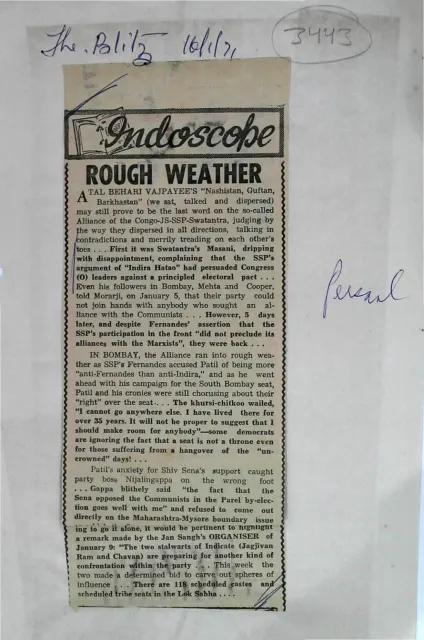
The Indoscope column “ROUGH WEATHER” surveys the internal strains of the electoral alliance involving Congress, Jan Sangh, SSP and Swatantra in the run-up to the 1971 elections. It presents the alliance as politically unstable, quoting Minoo Masani’s disappointment with the SSP’s alleged role in persuading Congress leaders to reject a principled pact, followed by reversals over possible cooperation with Communist and Marxist groups.
In Bombay, the article describes a further dispute between SSP leader George Fernandes and S. K. Patil, with Fernandes accusing Patil of being more “anti-Fernandes than anti-India.” It also reports Patil’s concern about Shiv Sena’s support, party-president S. Nijalingappa’s refusal to intervene directly in the Maharashtra–Mysore boundary issue, and a Jan Sangh warning that Jagjivan Ram and Chavan were preparing another confrontation within the Congress. The column closes by noting that 118 Lok Sabha seats were reserved for Scheduled Castes and Scheduled Tribes. The author is not identified on the rendered clipping; the date “16/1/71” is handwritten above it rather than printed in the article.
Key points
- The article portrays the Congress–Jan Sangh–SSP–Swatantra electoral alliance as fragmented and mutually distrustful.
- Minoo Masani is quoted criticizing the SSP’s alleged influence on Congress leaders’ rejection of a principled electoral pact.
- The parties reportedly reversed positions over alliances with Communists and Marxists within days.
- In Bombay, George Fernandes accused S. K. Patil of being more anti-Fernandes than anti-India during Patil’s South Bombay campaign.
- Patil’s concerns about Shiv Sena support are linked to a dispute with party president S. Nijalingappa.
- The article refers to a Jan Sangh warning of an impending confrontation involving Jagjivan Ram and Chavan inside the Congress.
- The column notes that 118 Lok Sabha seats were reserved for Scheduled Castes and Scheduled Tribes.
Metadata and summary are AI-extracted from the source PDF and reviewed for editorial accuracy. The original work is available via the Read PDF tab above (where present); paragraph-level citation inside the PDF is deferred to a future engagement.