
minutes · report
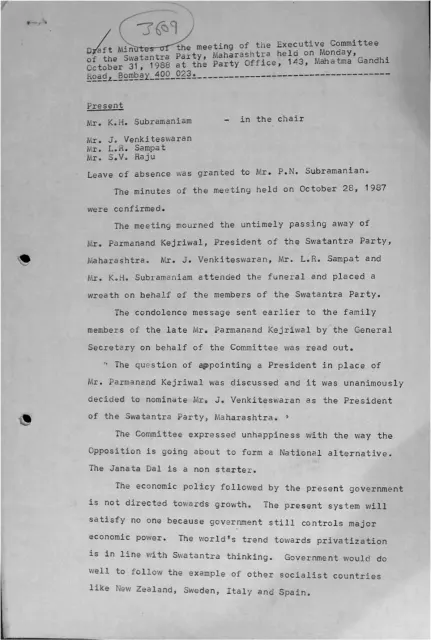
Draft Minutes of the meeting of the Executive Committee of the Swatantra Party, Maharashtra held on Monday, October 31, 1988 at the Party Office, 143, Mahatma Gandhi Road, Bombay 400 023.
Swatantra Party · Bombay · 1988
10 pages
Summary
These draft minutes record the meeting of the Swatantra Party, Maharashtra Executive Committee held on October 31, 1988, at the party office in Bombay. The committee confirmed the previous meeting’s minutes, mourned the death of Maharashtra party president Paramanand Kejriwal, recorded members’ attendance at his funeral, and unanimously nominated J. Venkiteswaran to succeed him as president. It also noted dissatisfaction with the opposition’s attempts to form a national alternative, dismissing the Janata Dal as a “non starter.”
The minutes present a forceful economic critique of the contemporary government. They argue that government control of major economic power is obstructing growth and that privatization accords with Swatantra principles. The discussion points approvingly to liberalizing moves in socialist countries, including the USSR and China, and urges India to reduce bureaucratic procedures. It describes the balance-of-payments position and the rupee’s value as alarming. The committee also condemned the decision to reinstate 200 constables disciplined after the 1982 police revolt, arguing that it encouraged indiscipline, before briefly reviewing party office premises and ending the meeting with a vote of thanks.
Key points
- The Executive Committee met in Bombay on October 31, 1988, with K. H. Subramaniam in the chair.
- Previous minutes from October 28, 1987, were confirmed, and leave was granted to P. N. Subramanian.
- The committee mourned Maharashtra party president Paramanand Kejriwal and nominated J. Venkiteswaran as his successor.
- The minutes criticize opposition efforts to create a national alternative and call the Janata Dal a “non starter.”
- The committee argues that government control of major economic power is incompatible with growth and supports privatization.
- The discussion compares India’s economic policy unfavorably with liberalizing reforms in the USSR and China.
- The committee describes the balance-of-payments position and the rupee’s value as alarming.
- It condemns the reinstatement of 200 constables disciplined after the 1982 police revolt.
Metadata and summary are AI-extracted from the source PDF and reviewed for editorial accuracy. The original work is available via the Read PDF tab above (where present); paragraph-level citation inside the PDF is deferred to a future engagement.
Related across the archive
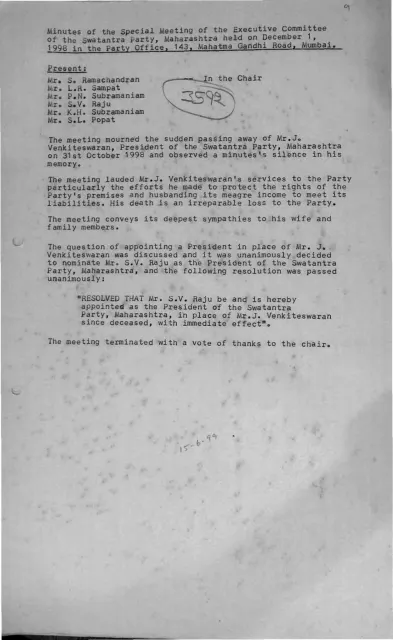 Primary workMinutes of the Special Meeting of the Executive Committee of the Swatantra Party, Maharashtra held on December 1, 1998 in the Party Office, 143, Mahatma Gandhi Road, Mumbai.
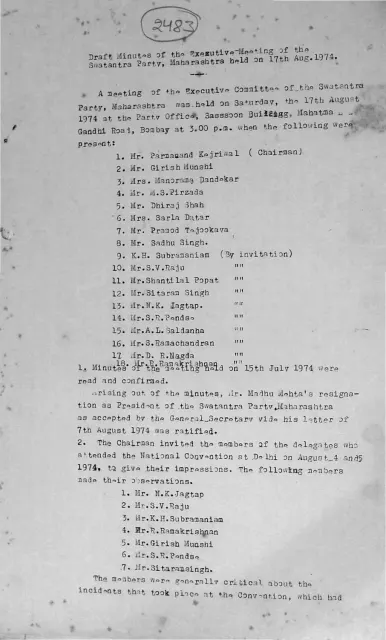 Primary workDraft Minutes of the Executive-Meeting of the Swatantra Party, Maharashtra held on 17th Aug.1974.
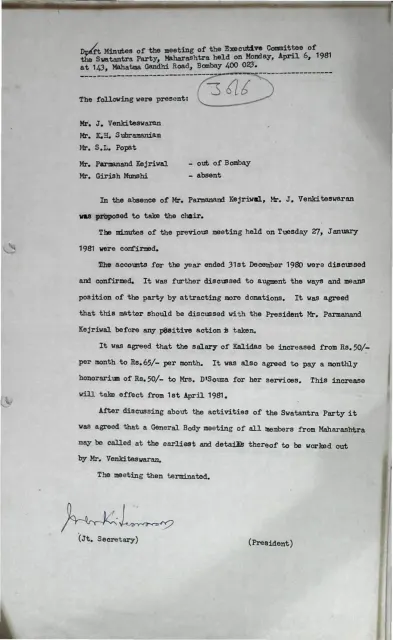 Primary workDraft Minutes of the meeting of the Executive Committee of the Swatantra Party, Maharashtra held on Monday, April 6, 1981 at 143, Mahatma Gandhi Road, Bombay 400 023.
 ExcerptNational Priorities for 1970
 OpinionThe Aborted Promise of Economic Liberalisation in Mid-1960s