pamphlet
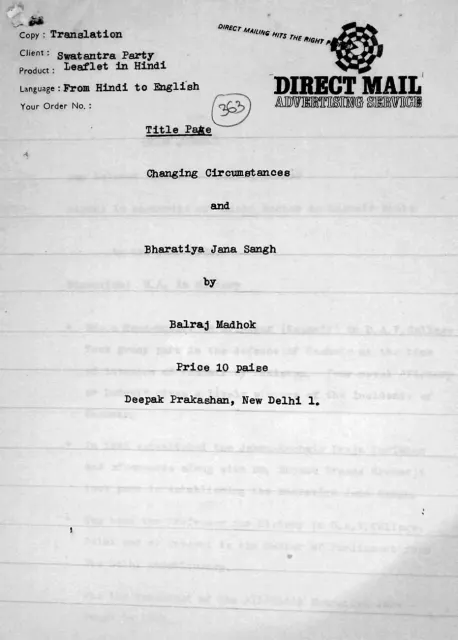
Changing Circumstances and Bharatiya Jana Sangh
Deepak Prakashan, New Delhi 1. · New Delhi 1.
22 pages
Summary
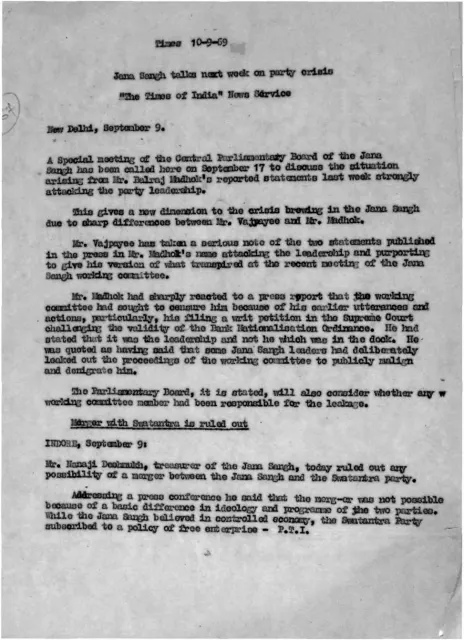
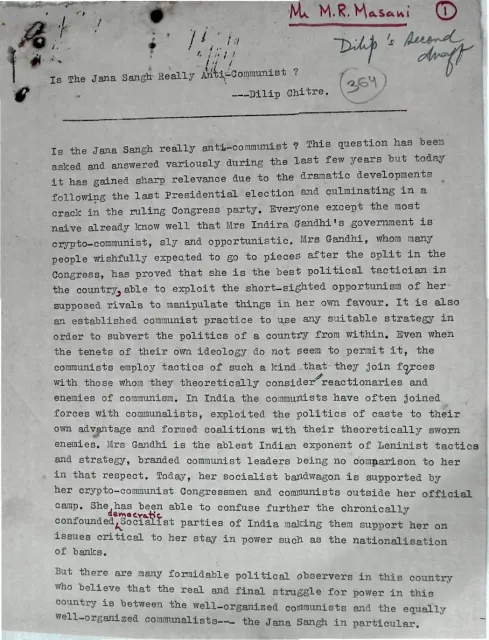
In the rendered pages, Balraj Madhok presents Bharatiya Jana Sangh as a nationalist party confronting a rapidly changing political environment after the 1967 elections and the split in the Indian National Congress. He argues that the Congress division reflects both personal rivalries and deeper ideological differences, contrasting Jawaharlal Nehru’s internationalism and socialist economic orientation with Vallabhbhai Patel’s nationalism and preference for more restrained financial policies. The pamphlet also criticises Indira Gandhi’s leadership, her dependence on the Congress Syndicate, and what Madhok describes as an increasing alignment with Soviet, communist, and communal forces.
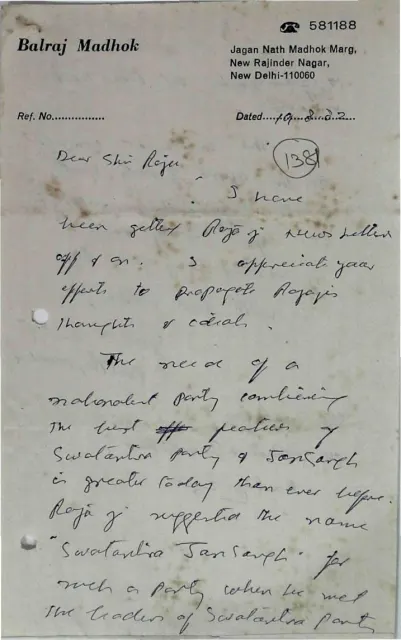
In the rendered pages, Madhok urges Jana Sangh workers to treat the political crisis as an opportunity for broader cooperation among nationalist and democratic parties, including the Swatantra Party and the Nijalingappa Congress. He defends competition, private production, and a limited state role in finance, opposing nationalisation and what he calls a monopolistic state economy. He also insists that Jana Sangh should preserve its distinctive nationalist and Hindu cultural identity while practising democracy internally through tolerance and freedom of thought. The surviving final rendered page begins a further discussion of Indian Muslims and cultural nationalism; pages 21–22 were not rendered.
Key points
- The pamphlet frames post-1967 Indian politics as a decisive crossroads for the country and for Bharatiya Jana Sangh.
- Madhok interprets the Congress split as the outcome of both leadership rivalries and ideological conflict.
- Jawaharlal Nehru is criticised for internationalism, socialism, and policies that Madhok associates with economic stagnation and vulnerability on Tibet and national security.
- Vallabhbhai Patel is presented as a contrasting nationalist figure committed to more truthful financial policies and a firmer external outlook.
- The pamphlet argues that Jana Sangh should cooperate with other nationalist and democratic parties rather than remain isolated.
- Madhok defends competitive economic activity and private producers while opposing state monopoly and indiscriminate nationalisation.
- The organisation is urged to combine social change with democratic and peaceful methods, tolerance, and freedom of thought.
- Jana Sangh’s nationalist and Hindu cultural identity is described as central to its political distinctiveness, while the text rejects the principle of two separate countries.
Metadata and summary are AI-extracted from the source PDF and reviewed for editorial accuracy. The original work is available via the Read PDF tab above (where present); paragraph-level citation inside the PDF is deferred to a future engagement.