essay
Monument to a historic meeting
Sunday Standard, Vijayawada · Vijayawada · 1973
1 pages
Summary
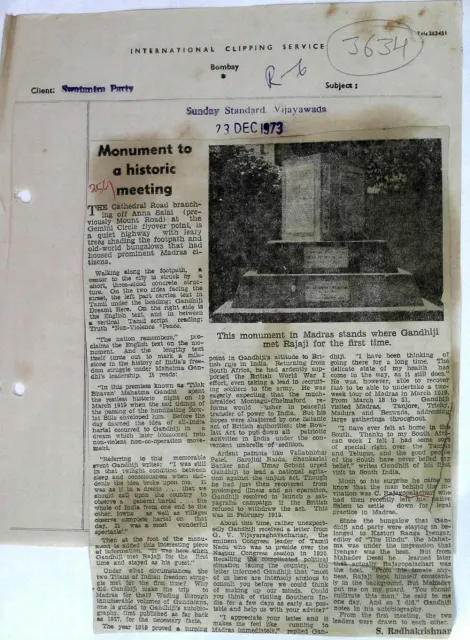
This newspaper article describes a small monument on Cathedral Road, Madras, marking the site where Mahatma Gandhi first met C. Rajagopalachari. The monument bears Tamil and English inscriptions, including the claim that Gandhi’s first visit to Madras in March 1919 initiated a historic phase in India’s freedom struggle. The article presents the meeting as a turning point in Gandhi’s development of non-violent non-cooperation and recalls his later visits and public meetings in South India.
The account reconstructs the political circumstances of 1919: Gandhi had returned from South Africa, was responding to the Rowlatt legislation, and was preparing a satyagraha campaign against British rule. It also recounts Rajagopalachari’s household in Madras, where Gandhi stayed with Kasturi Ranga Iyengar, and describes the first meeting between the two men as the beginning of a lasting political relationship. The clipping closes by suggesting that Gandhi’s and Rajaji’s ideas drew them together despite their differences.
Key points
- The article explains the purpose and location of a monument on Cathedral Road, Madras.
- The monument commemorates Gandhi’s first meeting with C. Rajagopalachari.
- It connects Gandhi’s 1919 Madras visit with the Rowlatt Satyagraha and the emergence of non-violent non-cooperation.
- The article recounts Gandhi’s visits and public meetings in South India during March 1919.
- It describes Rajagopalachari’s household and Kasturi Ranga Iyengar’s role as Gandhi’s host.
- The meeting is presented as the beginning of a durable political and intellectual association between Gandhi and Rajaji.
Metadata and summary are AI-extracted from the source PDF and reviewed for editorial accuracy. The original work is available via the Read PDF tab above (where present); paragraph-level citation inside the PDF is deferred to a future engagement.