essay
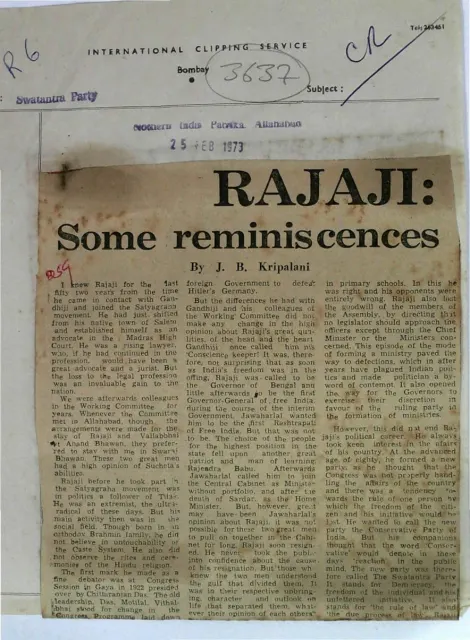
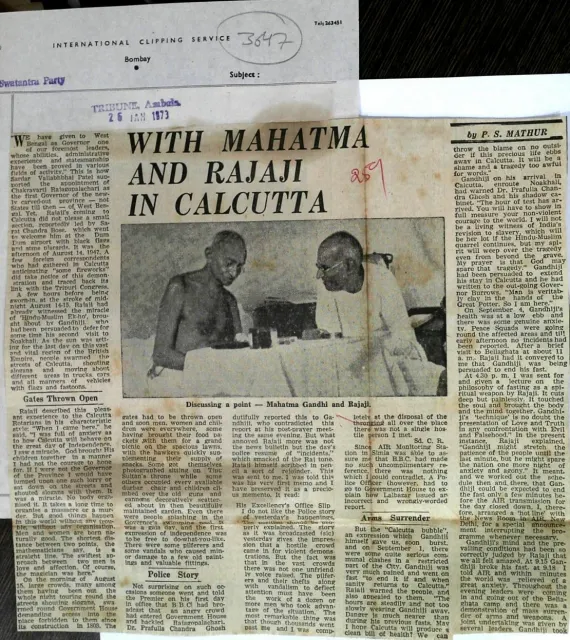
WITH MAHATMA AND RAJAJI IN CALCUTTA
TRIBUNE, Ambala · Ambala · 1973
3 pages
Summary
In the rendered pages, P. S. Mathur recounts the meeting of Mahatma Gandhi and C. Rajagopalachari (Rajaji) in Calcutta during the communal tension of August–September 1947. The article describes Gandhi’s arrival in Calcutta, the public response to his presence, the fragile peace surrounding his stay, and Rajaji’s efforts to support Gandhi’s fast and his non-violent intervention. It presents the episode as a moment when personal moral authority, public trust, and non-violence were brought to bear against communal violence.
In the rendered pages, Mathur also recalls Rajaji’s reflections on Gandhi’s legacy. Rajaji cautions against turning Gandhi into the founder of a rigid doctrine or formal memorial cult, while affirming Gandhi’s practical commitment to truth and non-violence. The article closes with Rajaji’s account of Gandhi’s spiritual influence and the importance of preserving his teachings as living practice rather than as an institutionalized dogma. The third rendered PDF page contains an apparently unrelated clipping fragment headed “Close Liaison” and is not part of this article.
Key points
- The article recalls Gandhi’s arrival in Calcutta amid communal anxiety and public unrest in August 1947.
- It describes large crowds, public demonstrations, and heightened security around Government House and Gandhi’s movements.
- Gandhi’s presence and fast are presented as instruments of non-violent moral pressure during a crisis.
- Rajaji is shown as supporting Gandhi while also offering an independent interpretation of Gandhi’s legacy.
- Rajaji argues against reducing Gandhi’s teachings to a formal doctrine, memorial, or religious cult.
- The account emphasizes truth, non-violence, spiritual force, and practical action as central to Gandhi’s example.
- The article’s final rendered page is an unrelated clipping fragment and does not contribute to the article’s subject.
Metadata and summary are AI-extracted from the source PDF and reviewed for editorial accuracy. The original work is available via the Read PDF tab above (where present); paragraph-level citation inside the PDF is deferred to a future engagement.