pamphlet · manifesto
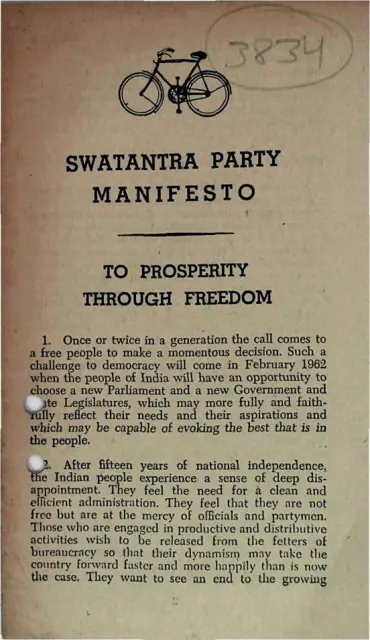
SWATANTRA PARTY MANIFESTO
TO PROSPERITY THROUGH FREEDOM
SWATANTRA PARTY · 1967
48 pages
Summary
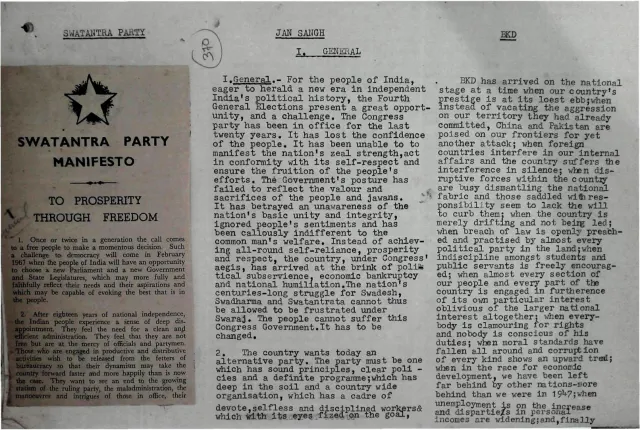
The Swatantra Party Manifesto presents the party as a democratic alternative to the Congress after eighteen years of centralized rule. In the rendered pages, it attributes India’s political and economic difficulties to Congress dominance, administrative inefficiency, corruption, excessive taxation, inflation, licensing and controls, dependence on foreign assistance, and the neglect of agriculture and small-scale industry. It argues that a vigilant Opposition is essential to prevent arbitrary government and that political power should be dispersed so citizens can exercise initiative and responsibility. The manifesto explicitly invokes C. Rajagopalachari’s principle that “government is best which governs the least.”
In the rendered pages, the programme emphasizes property rights, peasant proprietorship, opposition to compulsory collective farming, secure tenancy, credit and irrigation, improved seeds and fertilizers, fair agricultural prices, rural electrification, and employment outside agriculture. It opposes the concentration of economic power in the state and calls for a more decentralized pattern of industrial development, with government acting primarily as helper and regulator rather than participant. The document’s central economic argument is that prosperity depends on freedom, productive incentives, self-reliance, and the release of individual and local initiative. The rendered pages continue into the manifesto’s discussion of industry and trade, but the remainder of that section and later sections were not visible.
Key points
- The manifesto frames the 1967 elections as an opportunity to replace Congress rule with a principled and organized democratic alternative.
- It treats an effective Opposition as a safeguard against arbitrary government, corruption, maladministration, and the concentration of political and economic power.
- It advocates limited government, individual initiative, decentralized decision-making, and the protection of personal convictions and property rights.
- Its agricultural programme prioritizes peasant proprietorship, secure tenure, irrigation, rural credit, improved inputs, fair prices, and support for landless agricultural labour.
- It rejects compulsory collective or state-controlled farming while supporting voluntary cooperatives and reforms intended to increase agricultural productivity.
- It criticizes centralized economic planning, inflation, excessive taxation, licensing, and dependence on foreign loans and imports.
- It proposes small-scale and village industries, rural electrification, non-agricultural employment, and balanced development as ways to improve the position of the common man.
Metadata and summary are AI-extracted from the source PDF and reviewed for editorial accuracy. The original work is available via the Read PDF tab above (where present); paragraph-level citation inside the PDF is deferred to a future engagement.