minutes
MINUTES.
SWATANTRA PARTY PARLIAMENTARY OFFICE. · NEW DELHI · 1970
2 pages
Summary
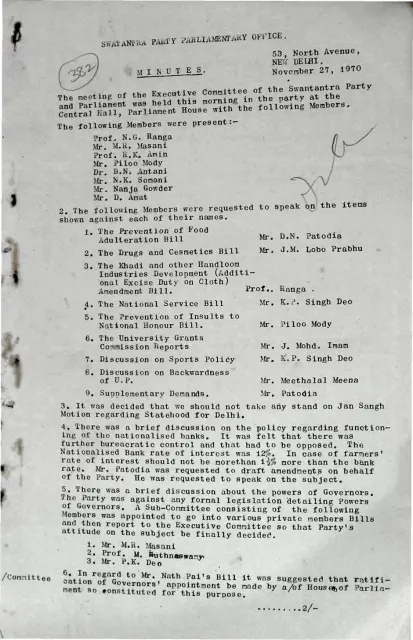
These two pages record the Swatantra Party Executive Committee and Parliamentary Party meeting held at Central Hall, Parliament House, New Delhi, on November 27, 1970. The minutes list those present and assign party members to speak on parliamentary business, including bills concerning food adulteration, drugs and cosmetics, handloom industries, national service, national honour, university grants, sports policy, backwardness in Uttar Pradesh, and supplementary demands.
The committee decided not to take a position on a Jan Sangh motion seeking statehood for Delhi. It discussed opposition to further bureaucratic control over nationalised banks, proposed a limit on farmers’ interest rates relative to the bank rate, and asked Mr. Patodia to draft amendments. The minutes also record opposition to formal legislation defining the powers of Governors, the appointment of a sub-committee to examine private members’ bills, a decision to avoid controversy over a Delhi University lecturer until a university sub-committee reported, and a directive that all Rajya Sabha business be discussed by the Executive Committee. Attendance on important divisions was also stressed.
Key points
- The Swatantra Party’s Executive Committee and Parliamentary Party met in New Delhi on November 27, 1970.
- Members were assigned speaking responsibilities across a broad list of parliamentary bills and policy discussions.
- The party chose not to take a stand on the Jan Sangh motion concerning statehood for Delhi.
- The committee opposed additional bureaucratic control over nationalised banks and proposed preferential interest-rate treatment for farmers.
- The party opposed formal legislation detailing the powers of Governors and appointed a sub-committee to review related private members’ bills.
- The minutes stress member attendance during important divisions and require future Rajya Sabha business to be considered by the Executive Committee.
Metadata and summary are AI-extracted from the source PDF and reviewed for editorial accuracy. The original work is available via the Read PDF tab above (where present); paragraph-level citation inside the PDF is deferred to a future engagement.