report · report
A MODEL QUARTERLY REPORT FROM A PROSPECTIVE PARLIAMENTARY CANDIDATE
Swatantra Party · 1965
10 pages
Summary
This report records the organisation, finances, staffing, touring, and electoral work of the Swatantra Party’s three-member committee for the Balangir Parliamentary Constituency during May–July 1965. The committee approves monthly expenditure, appoints paid and honorary workers, establishes reporting procedures, supports constituency and block-level offices, arranges party flags and signboards, and considers publishing a weekly district newspaper. It also coordinates with the party’s General Secretary in Bombay and seeks contributions from neighbouring constituencies for shared organisational expenses.
The report presents constituency politics as a combination of routine administration and intensive local mobilisation. Party workers tour villages, recruit and supervise organisers, prepare for Assembly and Gram Panchayat elections, respond to Panchayat delimitation, and challenge Congress-aligned officeholders through no-confidence motions and complaints about corruption or misappropriation. The account repeatedly stresses party unity, vigilance, local leadership, personal contact with workers, and the need to counter Congress influence. It also reports visits by senior Swatantra Party figures, including Rajya Sabha member Sundarmani Patel, who addressed workers on party aims, sacrifice, corruption, and the need for sustained organisation.
Key points
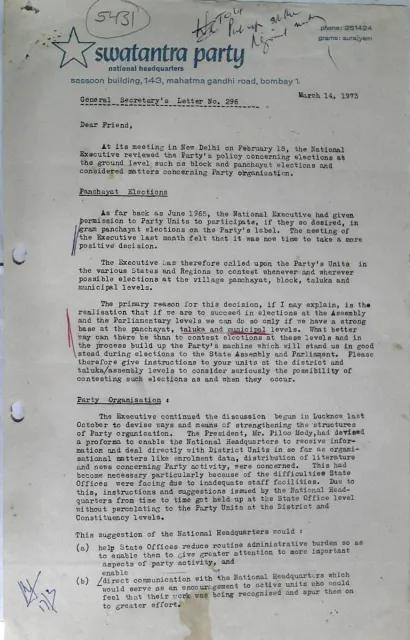
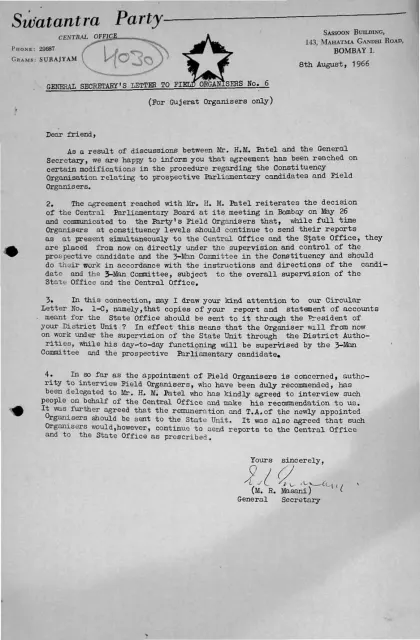
- The Balangir three-member committee approves expenditure and formalises quarterly reporting to the Swatantra Party’s central leadership.
- The committee appoints paid and honorary workers, fixes travel allowances, and expands party offices and communications infrastructure.
- A proposed weekly publication is intended to circulate widely through the district and strengthen party organisation.
- The report describes extensive touring, village meetings, worker recruitment, and preparation for Assembly, Gram Panchayat, and by-elections.
- Panchayat delimitation and local no-confidence motions are treated as major opportunities for political intervention.
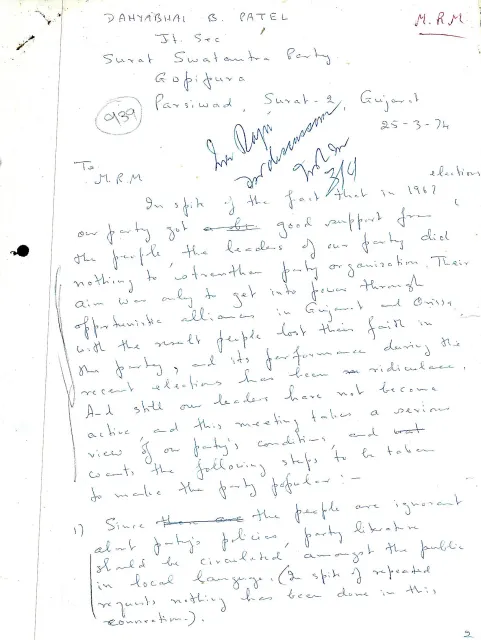
- The committee portrays Congress leaders and officeholders as divided, corrupt, or vulnerable to organised opposition.
- Repeated appeals for unity, vigilance, sacrifice, and personal engagement define the report’s practical political message.
Metadata and summary are AI-extracted from the source PDF and reviewed for editorial accuracy. The original work is available via the Read PDF tab above (where present); paragraph-level citation inside the PDF is deferred to a future engagement.